
- Tariffs (in some form) are here to stay, and they are impacting the cost of construction materials.
- Depending on budgets, tariffs may require redesign—from narrowing the scope of a project, to altering the materials used, to identifying different vendors for raw materials.
- Contract language should incorporate considerations for tariff fluctuations and time spent due to the resulting redesign.
Architects are constantly balancing design priorities with budgets and timelines. At the same time, the construction industry has seen tariffs increase the prices of raw materials and other imports. This begs the question: Have architects been altering their plans to account for pricing uncertainty? Depending on the contract and requisite materials, architects may need to consider redesign or alternative procurement strategies to work within an established budget.
The Tariff Landscape & Its Impact on Construction Costs
International Emergency Economic Powers Act (IEEPA) tariffs are being refunded. Even so, tariffs under different laws remain in place, and more are expected to come. As of the issuance of this article, examples of the tariffs that the architecture and construction industries are faced with include:
- Section 122: 10% global tariff (with exemptions in place), implemented until July 24, 2026
- Section 232: (impacted by recent changes)
- 50% tariff on raw steel, aluminum, and copper products
- 10% on softwood timber and lumber
- 10% to 50% on kitchen cabinets and vanities (depending on location and timing)
- Section 301: Implemented on China, rates vary
Section 301 tariff investigations are also underway, with the resulting tariffs likely implemented following the expiration of §122 tariffs noted above. Note that there are also agreements in place with various nations either on tariff rates generally or in relation to specific products. Figure 1, prepared by the Tax Policy Center, provides a visual of how the wide gamut of tariffs ultimately impacts the cost of final goods and services.1,2
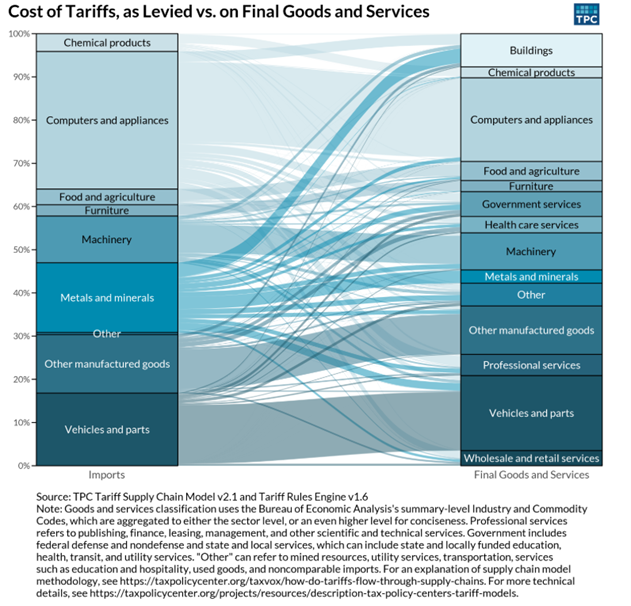
According to this source, buildings are impacted by tariffs on various imports, ultimately at a high cost. In theory, tariffs on imports may result in increasing revenue by domestic producers. The March 2026 Producer Price Index report from the U.S. Department of Labor (DOL) shows the following unadjusted 12-month percentage changes in cost:
| Groupings | % Change in Cost |
|---|---|
| Plastic construction products | 1.6% |
| Concrete ingredients and related products | 3.3% |
| Lumber and wood products | -0.3% |
| Metals and metal products | 15.7% |
(included within metals) | |
Builders’ hardware | 8.3% |
Iron and steel | 10.8% |
Plumbing fixtures and fittings | 9.3% |
Fabricated structural metal products | 7.5% |
| Furniture and household durables | 3.0% |
| Construction machinery and equipment | 4.7% |
| Architectural services | 1% |
| New nonresidential building construction | 3.3% |
Therefore, it appears that with the exception of metals and their related products, there has been around a 3% change in prices charged by domestic producers for certain architecture and construction-relevant products and services. Metals and metal product producers are clearly benefiting from much higher price increases, which likely correlates to the high §232 tariff rate mentioned previously.
It’s been established that tariffs will continue, that various tariffs apply to the architecture and construction industries, and that tariff pressures are likely (at least partially) allowing for domestic producers to charge more for their goods. Cushman and Wakefield provide projections that further delineate these impacts by building type. It projects that in 2026, construction costs will be higher than 2024 costs by the following amounts:3
| Building Type | Cost Increase (2024 to 2026) |
|---|---|
| Data centers | 3.4% |
| Retail | 3.2% |
| Industrial | 3.1% |
| Multifamily | 3% |
| Office renovation | 2.8% |
| Office | 2.8% |
This all seems to form a coherent and logical picture of the tariff landscape and its impacts, but at least one consideration proves anomalous. Even though domestic producers of construction materials are charging more for their products, they (at least in some cases) are producing less. From the 2021 to 2024 average, sources have reported the rate of domestic production of copper has decreased by 10.4%, gypsum by 6.3%, cement by 5.9%, and iron and steel by 0.1%.2 This is when intervening factors like regulations, plant maintenance, and labor limitations could be coming into play. Although domestic producers may be able to charge more to correlate with increased tariff rate trends, domestic producers are faced with practical challenges that are currently limiting their ability to compete with international players in many cases. This then leaves architects and contractors to continue navigating changes in tariff rates and the resulting implications for their customers.
Are Construction Costs Forcing Redesign?
As shown above, the producer price index for domestic architecture professionals has only gone up 1% in the past year. This may be due to bidding pressure as customers are working within a fixed budget despite increasing material costs. Amid ongoing projects, architects are further faced with whether tariff changes warrant redesign. The American Institute of Architects (AIA) indicates certain types of buildings have less pricing flexibility than others—namely institutional projects, warehouse projects, and apartments buildings, for example.4 AIA provides specific examples when redesign was considered in response to cost sensitivity:
“Axios Architects and Consulting in Chicago was pushed to downsize5 an eight-story apartment building by three stories due to rising costs, and Austin-based architecture firm Page found that a hotel project in nearby Round Rock, Texas,6 the Ruby Hotel, would be cheaper if the design was altered to utilize light gauge metal instead of wood, as it was originally intended.”
The options for redesign could include decreasing the scope of the project, switching out the type of materials, or altering vendors. Of course, changes to specs could have significant impacts on project timing, which inevitably carries its own cost implications. Projects in the preconstruction phase may be most vulnerable to these modifications. Therefore, preparedness in terms of due diligence with material and vendor options could prove helpful from both a budgetary and timing perspective. Architects may also need to include contractual language that addresses redesign and changes in market pricing due to tariffs or other factors.
To avoid the uncertainty that comes with changing tariffs, it may be prudent to discuss with project owners the use of locally sourced materials and plans that align with Leadership in Energy and Environmental Design (LEED) requirements. The U.S. Green Building Council (USGBC), the group that develops the LEED framework, holds that LEED buildings can result in 10% or greater increase in asset value.7 Coupled with the ability to charge higher rental rates per square foot (according to USGBC), there may be a broader argument outside of the tariff context for sourcing domestic and green compatible materials.
How Forvis Mazars Can Help
Understanding the changing landscape of costs can help to more accurately prepare bids and keep to an established budget. Reach out to a professional at Forvis Mazars to talk through the various type of tariffs that may impact your projects, and be sure to subscribe to our Tackling Tax podcast and From the Hill publication for the latest tariff developments.
- 1“TPC Tariff Tracker,” McClelland, Robert and Wong, John, taxpolicycenter.org, April 6, 2026.
- 2While Figure 1 displays the ultimate flow-through impact of tariffs, tariffs are only levied on goods and not services directly.
- 3“Impact of Tariffs on U.S. CRE Construction Costs,” Bohnaker, James and Ansari, Owais, cushmanwakefield.com, April 7, 2026.
- 4“Architects are navigating tariff pressures in an uncertain market,” Sisson, Patrick, aia.org, May 19, 2025.
- 5“Proposed West Ridge Apartment Building Likely To Be Downsized As Tariffs Raise Construction Costs,” blockclubchicago.org, April 23, 2025.
- 6“Top Austin architecture firm Page steers course through tariff uncertainty,” bizjournals.com, April 10, 2025.
- 7“Benefits of green building,” usgbc.org.