

Imagine navigating a ship through a storm without a map or radar. Hospitals without a strategic financial plan face similar challenges in today’s unpredictable healthcare environment. It’s no secret that hospitals and health systems have experienced a period of low profitability, with operating margins averaging in the low single digits in the past five years for many. Near-term pressures and potential headwinds from Washington, D.C., including declining research funding and uncertainty about the future of Medicaid and Medicare, have many feeling lost at sea.
At a moment like this, when the healthcare system is evolving rapidly amid fluctuating reimbursement models, aging infrastructure, staffing challenges, and a dynamic competitive landscape, previous business models no longer seem sustainable. Forward-thinking leaders know that an effective, well-designed strategic financial plan is fundamental to financial longevity. While balancing short-term demands with long-term sustainability is challenging, we see the strategic financial planning function as the compass, map, and radar that help guide hospital leadership to align resources, mitigate risks, and capitalize on opportunities.
The Role of Strategic Financial Planning
Strategic financial planning is a multifaceted process that integrates five elements:
- Evaluation of current, former, and future financial performances
- Capital planning
- Scenario analysis
- Risk assessment
- Performance metrics
Together, these five elements provide a clear map for helping achieve organizational financial objectives that incorporates forward-looking financial insights and long-term considerations. Strategic financial planning helps identify times for opportunistic growth endeavors and performance improvement initiatives. A strategic financial plan also helps hospitals strengthen their financial and operational goals while supporting the organization’s strategic and operational priorities. Strategic financial planning goes beyond maintaining the status quo; it focuses on upgrading financial health by driving growth and bridging operational gaps.
A key output of strategic financial planning is improved performance that provides financial and operational data and tools to address operating gaps—the shortfall between current financial performance and desired outcomes. This process involves identifying opportunities to streamline operations to help achieve lasting financial stability. Examples of performance improvement initiatives might include improving service distribution, redesigning care delivery, or enhancing workforce productivity. Strategic financial planning provides the data and tools necessary to prioritize and execute these initiatives effectively, helping hospitals navigate financial challenges and achieve their desired outcomes.
Growth initiatives are another output of strategic financial planning. These initiatives involve exploring opportunities to increase reach, scale, and/or impact through new products, services, and populations. While partnerships—such as joint ventures, mergers, or affiliations—are one avenue for growth, hospitals might also consider organically expanding service lines, entering new markets, or developing innovative care delivery models through their own capital investments. Regardless of the specific growth initiative chosen, hospital leaders need careful financial planning when evaluating partnership viability, strategic fit, and alignment with long-term goals.
Ultimately, strategic financial planning helps strengthen decision making by providing hospital leadership with a detailed, data-driven framework that supports informed decisions about growth opportunities, operational alignment, and risk management. With a solid plan in hand, leaders can confirm that any changes are aligned with the hospital’s overarching goals.
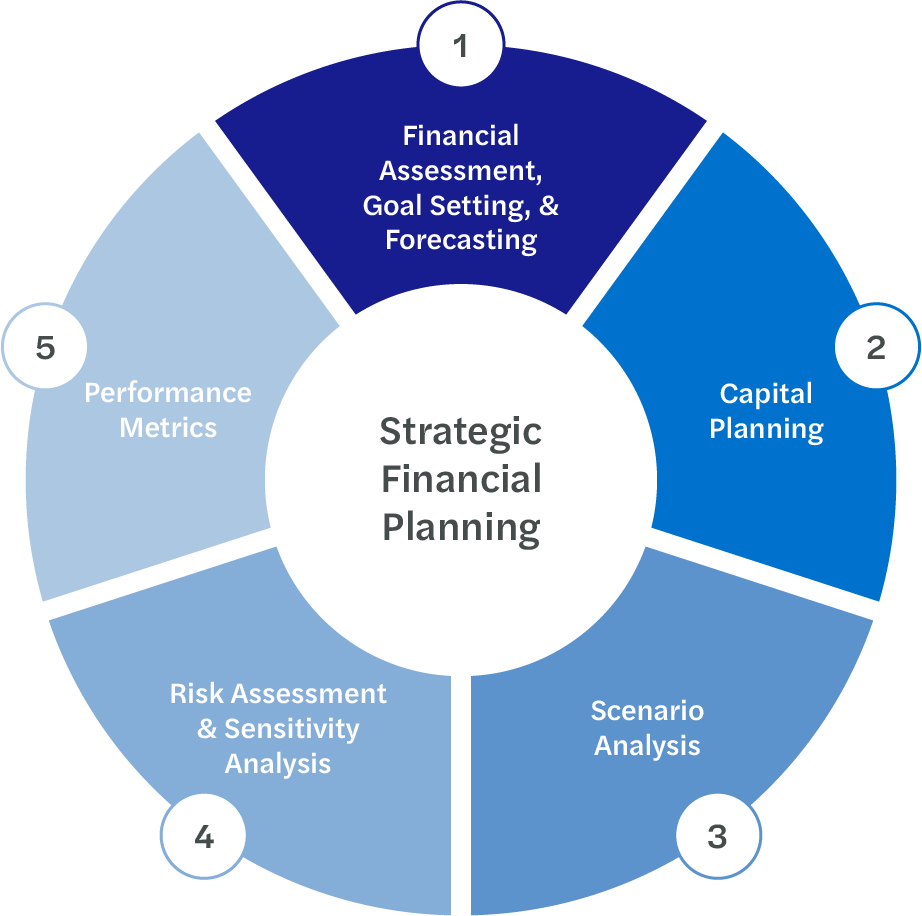
The Five Elements of Strategic Financial Planning
Financial Assessment, Goal Setting, & Forecasting
The first step of strategic financial planning is to evaluate current financial assessments, financial goals, and financial forecasting. This exercise allows a view into current and historical financial performance (current financial assessment), future plans (financial goal setting), and possible course corrections (financial forecasting). At this stage, hospital leaders chart estimated future revenue, expenses, and margins based on historical performance, market trends, and anticipated regulatory changes. Given all the moving parts, options, and trade-offs, leaders with established and realistic financial targets for key ratios will be better positioned to support their organization’s goals and strategic capital investments. This forward-looking component helps hospitals anticipate challenges and identify growth opportunities. Outcomes of this stage of financial planning include early indicators of areas where revenue growth is possible, as well as opportunities to reduce costs.
Capital Planning
The second element, capital planning, prioritizes investments in facilities, technology, and clinical programs, among other critical areas. At this stage, leaders articulate business cases for each project, including strategic rationale, pro forma financial impact, and return on investment. Each project can then be viewed within the strategic financial plan for a complete picture of capital projects going forward. By focusing on these capital priorities, hospitals can align investments with resources, budgets, and growth opportunities, which can help them maintain or improve market competitiveness.
Scenario Analysis
The third element of financial planning is scenario analysis, which enables hospitals to evaluate the potential impact of various operational challenges, such as shifts in reimbursement models, fluctuations in labor costs, or changes in patient volumes. Scenario planning helps leadership prepare for contingencies and remain flexible in the approach to addressing changing business environments. Hospital leaders should take an iterative approach at this stage, revisiting and refining the forecasting techniques and tools that guide their decisions, so they can identify the impact of changes to key assumptions driving the projections.
Risk Assessment
The fourth element, risk assessment, is another vital component of the financial planning process. At this phase, hospital leaders evaluate the financial impact of potential uncertainties—such as economic downturns, regulatory changes, or shifts in payor mix—and develop mitigation strategies to counterbalance any downside risk the organization may face. Scenario analysis helps leaders assess how these changes—ranging from reduced federal healthcare funding to increased labor costs—might affect operational budgets, supply chains, and long-term financial stability. These risks necessitate robust scenario planning, in which hospital leaders evaluate best-case, worst-case, and most-likely outcomes to prepare for financial shortfalls or operational inefficiencies. By quantifying risks and their potential effects, hospitals can make informed decisions and help strengthen their financial resilience.
Performance Metrics
The final element of financial planning is establishing performance metrics to measure financial health and progress toward strategic goals within an integrated budget and capital planning process. By tracking key performance indicators (KPIs) specific to their organization and goals, hospitals can monitor their performance and make data-driven adjustments as necessary.
Strategic financial planning provides the foundation to help hospitals and health systems navigate complex operational challenges and achieve long-term stability. The five elements of strategic financial planning—evaluating current financial assessments and goals, capital planning, scenario analysis, risk assessment, and establishing performance metrics—work in harmony to create a robust framework for decision making. Among these, capital planning emerges as a critical pillar, bridging the gap between financial strategy and operational execution.
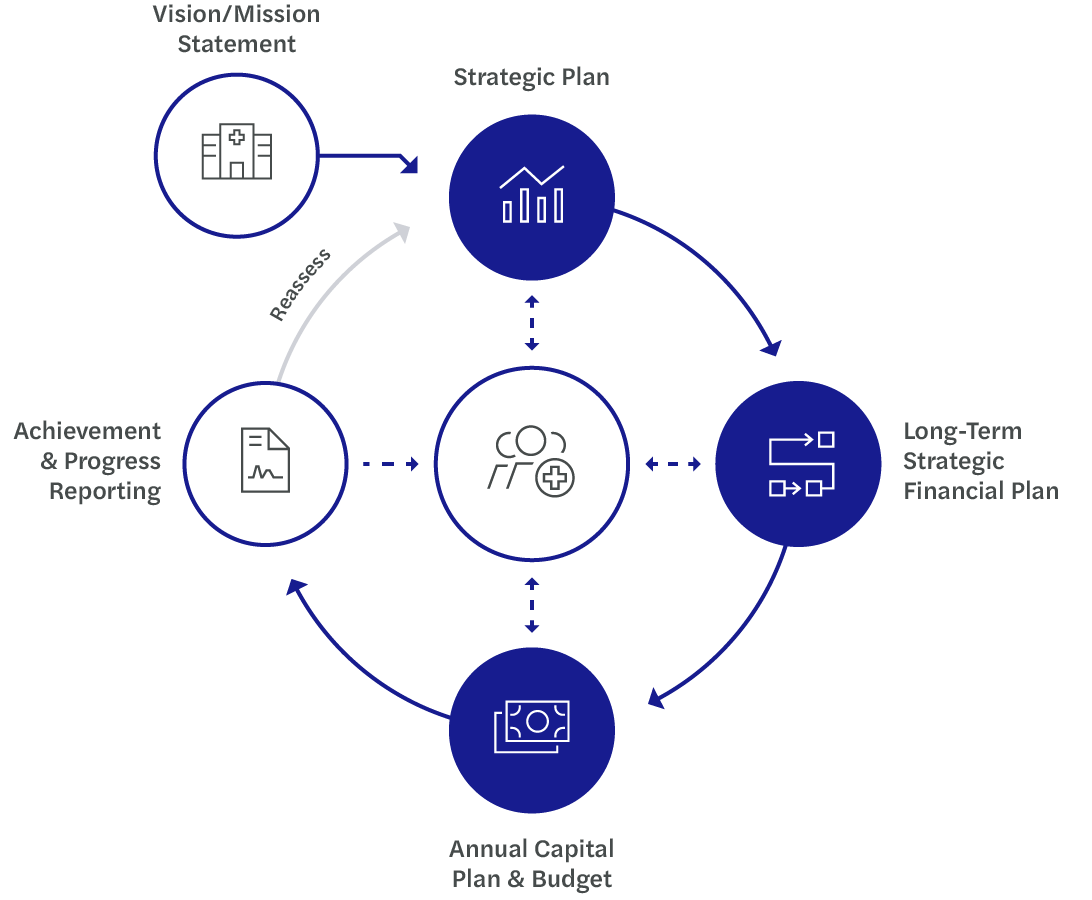
Capital Strategy: The Integration of Capital Planning & Budget Cycles
Strategic financial planning plays a key role in capital strategy, particularly in capital planning and annual budget processes. A well-defined long-term capital strategy, backed by a strong financial plan, helps align capital expenditures and short-term budgets with strategic priorities.
The primary function of capital planning is to align the capital decision-making process with the organization’s strategic, operational, and financial plan, driven by financial impact and cost-benefit considerations. Once complete, leaders can put forward a strategically aligned and effective capital plan to better understand upcoming capital investment needs.
The capital budget develops the strategic financial details required to implement specific strategic initiatives identified in the capital plan in the near term. While capital planning defines the long-term strategic initiatives, capital budgets dive one level deeper, allocating the required sources of capital to begin each project. This process involves assessing the anticipated revenue and margin impact, rate of return, and identified expenses of each strategic project. When leadership teams develop budgets, the process translates enterprise strategic initiatives into actionable pro formas.
A final piece in the capital budgeting process is continued performance monitoring against financial forecasts to help identify deviations from plans so that hospital leaders can make timely adjustments. This iterative process helps organizations remain on course, even as new challenges or opportunities arise.
How Forvis Mazars Can Help With Strategic Financial Planning
Strategic financial planning is an essential pillar of effective leadership in today’s evolving healthcare environment. For chief financial officers and hospital executives, it is not just a strategic tool, but a business imperative that underpins organizational success. By fostering a clear financial vision, providing actionable insights, and aligning resources with the organization’s highest priorities, hospitals can build a solid foundation for long-term financial sustainability.
With a well-crafted strategic and financial plan, healthcare institutions can navigate the complexities of the industry with confidence. This proactive approach helps hospitals weather economic uncertainties, improve resource allocation, and make informed decisions that enhance both operational efficiency and financial performance. As financial landscapes become increasingly intricate, a thoughtful financial plan helps equip hospitals to not only survive but thrive in the face of emerging challenges, sustaining financial health and supporting their mission of achieving health in the communities they serve.
At Forvis Mazars, our professionals have extensive experience assisting healthcare organizations throughout the strategic financial planning process. If you have questions or would like assistance, please reach out to our team today.