

The Rural Health Transformation Program (RHTP) is moving into its next phase. With awards issued at the end of 2025, the focus now shifts to how states will implement initiatives and advance their rural health goals. For subrecipients, including rural healthcare providers, this moment brings both opportunity and responsibility, including the need to align with state strategies, understand eligible activities, and prepare to meet compliance requirements. This article breaks down what prospective subrecipients should understand as states begin rolling out their RHTP funding opportunities, including a high-level timeline, priority areas, compliance considerations, and how to prepare for participation.
RHTP Timeline: What’s Happening Now
As states move from application to execution, several key deadlines and activities are shaping early 2026.
The following timeline illustrates the key dates shaping this next phase of the program.
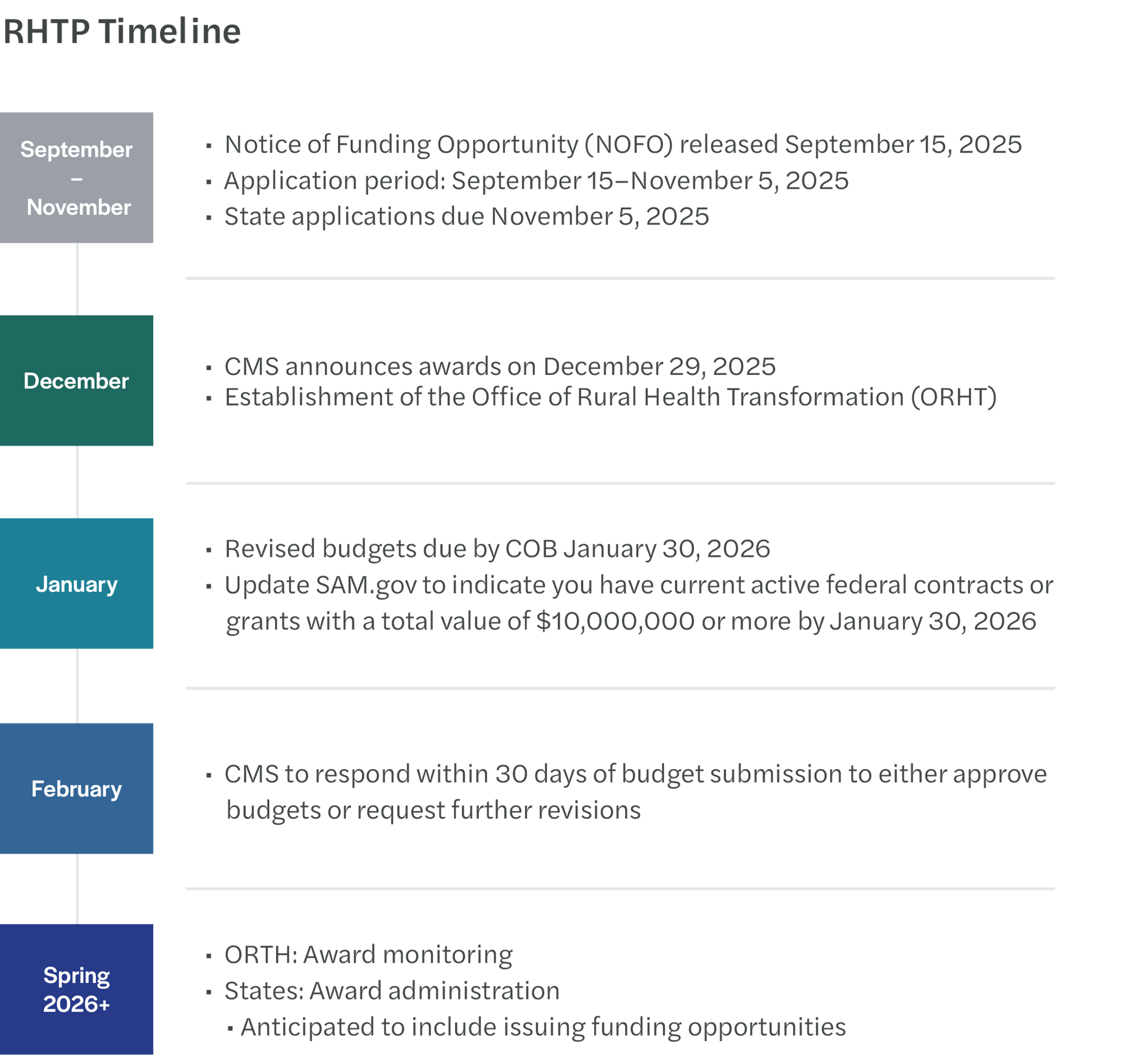
In December 2025, CMS announced state RHTP awards, with funding ranging from $147 million to $281 million and averaging roughly $200 million nationwide.1 These allocations are now being used by each state to update and adjust their budgets that are due by January 30, 2026.
As states adjust their budgets to align with their final award amounts, they will likely be evaluating how best to initiate the activities outlined in their applications. These decisions will influence which initiatives proceed, how resources are allocated, and which entities they are likely to engage as they transition from planning into execution.
Understanding Eligible Activities, State Priorities, & Subrecipient Opportunities
Eligible Activities & State Priorities
The Notice of Funding Opportunity (NOFO) outlines a wide range of eligible uses for the RHTP funding.2 The eligible activities under this award fall into the following 11 categories:
- Prevention and chronic disease
- Consumer tech solutions
- Workforce
- Appropriate care availability
- Innovative care
- Fostering collaboration
- Provider payments
- Training and technical assistance
- IT advances
- Behavioral health
- Capital expenditures and infrastructure—for existing healthcare facility buildings
It is important to highlight that while there are numerous eligible uses for these funds, each state was responsible for determining which activities and initiatives would be deployed for their specific healthcare needs.
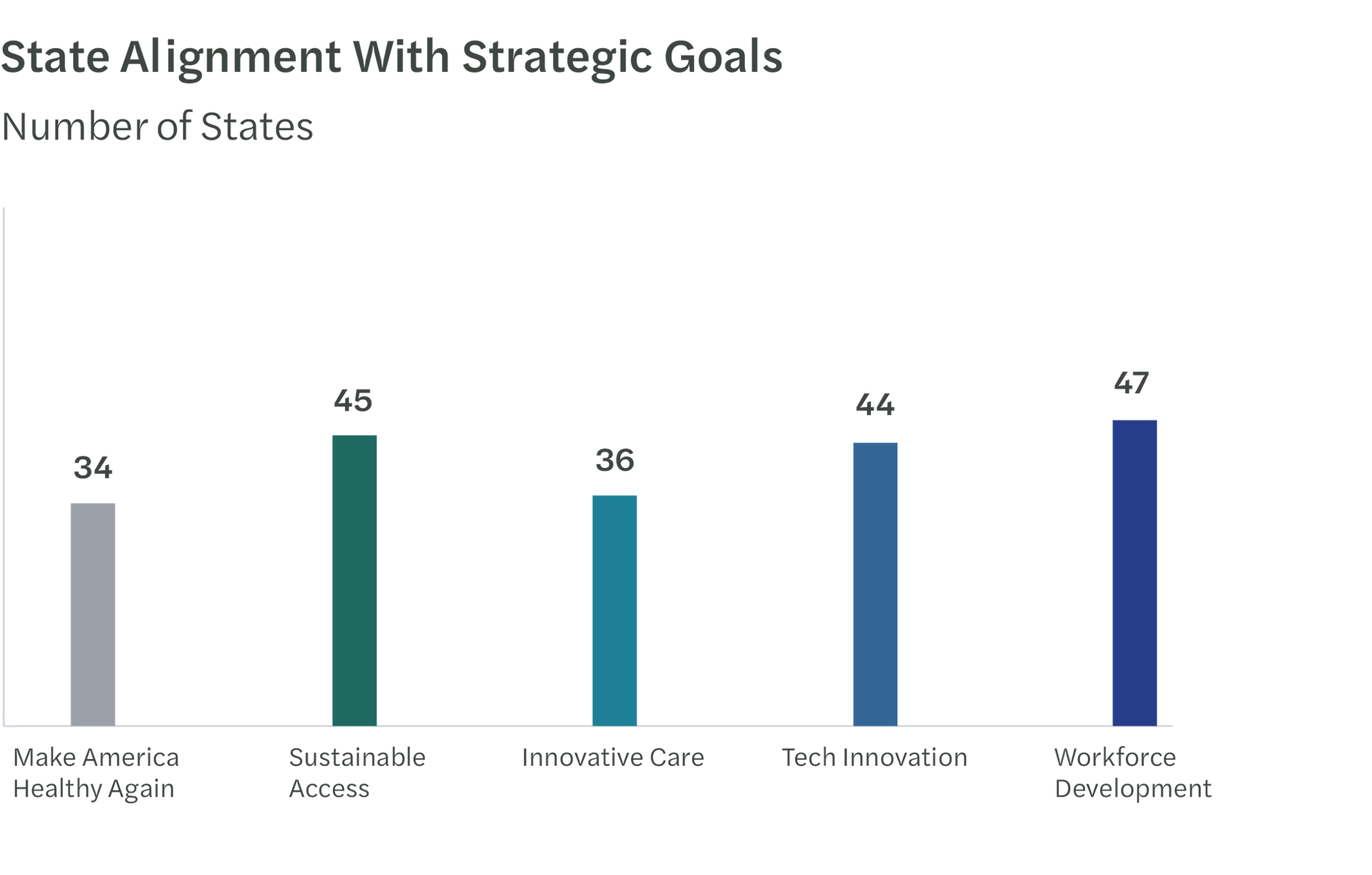
Each state was required to submit an application to CMS by November 5, 2025. This was to outline their proposed rural health transformation plan, priority initiatives, and a budget—using a model award amount of $200 million—to show how they would allocate funding across the program’s strategic goals.
The table below shows the number of states that included at least one initiative in each of the five strategic goals listed in the NOFO.3
The state applications are a major source of information, detailing the goals and initiatives of each state’s RHTP funding. Reviewing the applications can help potential subrecipients anticipate opportunities and prepare competitive responses once funding announcements are released. Key information available in these applications includes the following:
- The state’s strategic RHTP goals, which can advise on what type of projects they plan to pursue.
- Types of activities the state intends to conduct directly, as well as activities that may be delegated to subrecipients or procured through contractors.
- The state’s established key partnerships or intended subrecipients.
- The outcomes and milestones that the state anticipates achieving under the RHTP award.
State abstracts can be found here. Full state applications should be available through CMS or your state’s website.
When Subrecipient Opportunities Are Likely to Emerge
States have discretion in determining which organizations can serve as subrecipients. Entities best positioned for RHTP funding will be those that:
- Understand their state’s chosen priority areas.
- Can demonstrate alignment with the state’s proposed outcomes and milestones.
- Have capacity to execute projects within federal program requirements.
Organizations should begin preparing now by:
- Reviewing their state’s plan.
- Identifying which initiatives align with their expertise.
- Building internal capacity for compliance and reporting.
- Preparing to respond quickly once the state issues funding opportunities.
Compliance Responsibilities & Reporting Requirements
As states begin to implement the RHTP, many compliance requirements and reporting obligations will flow down to subrecipients. Similar to other federal awards, while states are accountable to CMS, subrecipients are anticipated to be required to provide documentation and data to states to support compliance with federal expectations.
Compliance Expectations for Subrecipient
Similar to any other federal award, the RHTP has compliance expectations. Subrecipients should be prepared to align with the following key compliance requirements:
- Subject to applicable federal statutes, regulations, and terms passed down from the state, including the applicable requirements of 2 CFR 2004 and 2 CFR 300.5
- Maintain an active SAM.gov registration and update responses related to federal award thresholds and integrity disclosure annually (2 CFR 25.2006 and RHTP Specific Terms and Conditions7 ).
- Prior approval may be required for changes in scope, key personnel, or budget reallocations (2 CFR 200.308, CMS Standard Terms and Conditions8 ).
- Funds must only be used for allowable costs, and not for the following unallowable costs:
- Pre-award expenses
- Construction of new facilities
- Lobbying
- Services reimbursable by other programs
- Comply with the program-specific funding caps imposed on states:
- Provider payments: No more than 15% of the total budget period
- Electronic medical records (EMR) replacements: No more than five percent of a certified system existed as of September 1, 2025
- Infrastructure/renovation: No more than 20% of budget per period
- Rural tech catalyst-type initiatives: No more than 10% or $20 million per period
- Additional limitations found in SSA Section 2105(c)9
- May be required to participate in CMS-facilitated learning collaboratives, monthly check-ins, and evaluations (RHTP Program Terms and Conditions).
- Subject to enforcement and remediation for non-compliance which may result in corrective actions plans, reductions in funding, or award termination.
In a similar vein as compliance, subrecipients are anticipated to have reporting requirements associated with their awards.
Reporting Requirements: What Subrecipients Should Expect
Subrecipients may be asked to contribute, in the form of data submission or state-specific reports, to the state’s required reporting to CMS. The table below outlines the state reporting requirements for the first period of performance, as well as the anticipated subrecipient impact of those reporting requirements.
| Reporting Type | Reporting Periods | Due Dates | Responsible Party | Subrecipient Impact |
|---|---|---|---|---|
| Progress |
| 30 days after the end of the period | States |
|
| Financial |
| 1/28/27 | States |
|
| FFATA |
| 30 days after subaward | States & Subrecipients |
|
Monitoring & Audit Readiness
CMS is responsible for overseeing the program at the federal level, and as such will work with the states. However, states are responsible for monitoring subrecipients and assessing their risk of non-compliance in accordance with 2 CFR 200.332. As such, subrecipients should be prepared to meet the following expectations:
- Maintain documentation of expenditures, procurement, and programmatic activities.
- Track performance through metrics and milestones in specific alignment with the state’s RHTP goals.
- Timely respond to state requests for data, records, or clarifications.
- Participate in site visits, deck reviews, or other monitoring activities as required by the state.
- Update policies, procedures, and internal controls as needed to comply with 2 CFR 200, 2 CFR 300, terms and conditions of the award, and other federal requirements.
In addition, subrecipients who expend $1 million or more in federal funds during their fiscal year must be prepared to participate in a Single Audit, as required by 2 CFR 200 Subpart F. These audits are to be completed and subsequently submitted to the Federal Audit Clearinghouse within nine months after the end of the fiscal year and may be reviewed by the state or CMS for findings related to the RHTP award.
Subrecipients should take special care to be audit-ready and maintain systems and practices that successfully demonstrate how RHTP funds were used, how programmatic and financial decisions were made, and how specific outcomes and goals were achieved.
How Forvis Mazars Can Support Subrecipients
The RHTP offers an exciting opportunity to strengthen rural healthcare through innovative and community driven initiatives. For subrecipients, success under the program will depend on more than just a compelling application—it will require alignment with state priorities, a deep understanding of eligibility activities, and a strong foundation in federal grant compliance.
With our national reach and focus in grants management and healthcare consulting, Forvis Mazars is uniquely positioned to support subrecipients in all 50 states through the entire grant life cycle, from application to close-out. Whether you need assistance identifying funding opportunities, preparing applications, establishing and maintaining compliance systems, or managing post‑award and close-out activities, our team is here to help you build the infrastructure and confidence your organization needs to succeed.
If you have any questions or need assistance, please reach out to a professional at Forvis Mazars.
- 1“CMS Announces $50 Billion in Awards to Strengthen Rural Health in All 50 States,” cms.gov, December 29, 2025.
- 2“Rural Health Transformation Program Notice of Funding Opportunity,” grants.gov, September 15, 2025.
- 3“RHT Program State Project Abstracts,” cms.gov, December 2025.
- 4“Code of Federal Regulations: 2 CFR 200,” ecfr.gov, January 29, 2026.
- 5“Code of Federal Regulations: 2 CFR 300,” ecfr.gov, January 29, 2026.
- 6“Code of Federal Regulations: 2 CFR 25.200,” ecfr.gov, January 29, 2026.
- 7“CMS Notice of Award,” health.wyo.gov, December 29, 2025.
- 8“CMS Standard Grant/Cooperative Agreement Terms and Conditions,” cms.gov, May 15, 2023.
- 9“Social Security Act: Section 2105(c),” ssa.gov, 2026.
- 10“Code of Federal Regulations: Appendix A to Part 170, Title 2,” ecfr.gov, January 29, 2026.