

The enterprise artificial intelligence (AI) landscape is undergoing a fundamental shift. What began as predictive analytics and chatbots has evolved into something far more consequential: autonomous agents capable of reasoning, acting, and adapting across business systems with minimal human intervention.
For CIOs, CFOs, and IT leaders, this represents both an opportunity and an imperative: organizations that thoughtfully deploy agentic AI will gain measurable competitive advantage. Those that don’t take this opportunity risk falling behind competitors who can operate faster, leaner, with greater precision, and with reduced risk.
The stakes are clear. Research from an IDC study sponsored by Microsoft indicates that companies achieve an average 10 times the return for every dollar invested in AI, with generative AI (GenAI) deployment taking approximately eight months and value realization occurring within 13 months.1
However, realizing this value requires more than adopting new technology; it necessitates fostering a culture of innovation and securing stakeholder buy-in for a transformational shift in how work is done.
What Makes Agentic AI Different
Automation and traditional AI can assist humans. Agentic AI can take action on their behalf.
The distinction matters. Earlier generations of enterprise AI focused on augmentation, surfacing insights, answering questions, and generating content. These capabilities remain valuable, but they require constant human direction. Agentic AI operates differently. This generation of technology can understand objectives, navigate complex workflows, make contextual decisions, and execute tasks autonomously within defined guardrails.
Consider the evolution: traditional AI might flag a supply chain exception and recommend next steps. Agentic AI identifies the exception, drafts supplier communications, updates purchase orders in Microsoft Dynamics 365, and monitors resolution. It can do all of this while maintaining audit trails and escalating only when predefined thresholds are breached.
Microsoft Dynamics 365 Supply Chain Management now includes supplier communications agents that handle these exact workflows, reducing manual follow-ups and exception handling across procurement operations.
As noted at the recent Dynamics Community Summit, “this isn’t science fiction.” 2025 marks the year that the “Frontier firm” is born, according to Microsoft.2 Frontier firms are early adopters of AI with enterprisewide deployment, advanced maturity, and a belief in the return on investment (ROI) of AI.
Agentic AI isn’t replacing humans. It’s redefining how humans, technology, and machines can collaborate to create value.
The Maturity Journey: Five Levels of Agentic Transformation
Enterprise automation and AI adoption should follow a predictable maturity curve. Understanding where your organization sits, and where it needs to go, is essential for strategic planning and resource allocation.
The five levels described below represent distinct capabilities and approaches to enterprise automation and agentic AI. These levels are not a required or linear progression. Organizations may initiate pilots or projects at any level, depending on strategic goals, readiness, and business needs.
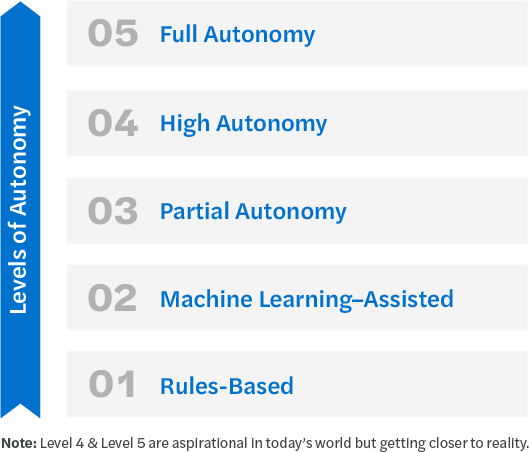
Movement between levels is not strictly sequential. Many organizations will pursue multiple levels in parallel or may “jump” directly to higher levels as technology and business priorities allow. Strategic vision, pilot programs, and operationalization are relevant at each stage, and an ideal starting point will vary for each organization.
Think of these levels like different types of vehicles: a bicycle, a high-performance bicycle, a car, a race car, and a spaceship. You don’t have to start with a bicycle and work your way up; your organization can choose the vehicle (level) that best fits your journey and goals.
Level 1: Rules Based
Organizations set a strategic vision for automation and AI, grounded in business outcomes. Executive sponsors are engaged early, and an AI Center of Excellence (CoE) is established to drive cross-functional collaboration. Data readiness assessments and responsible AI settings are foundational.
AI Role: Exploratory and assistive. Follows predefined rules or scripts to perform tasks.
Examples:
- Robotic process automation (RPA) for data entry (precursor to AI)
- Low-code application for data capture
- Microsoft 365 Copilot used to augment individual productivity in drafting, summarizing, and analyzing
Level 2: Machine Learning–Assisted
Targeted pilots, like chatbots or analytics agents, are launched across business units. Teams experiment, upskill, and begin to see tangible benefits. Governance frameworks are introduced to enable responsible use.
AI Role: Automation or task-specific agents begin to support teams through constrained decisions or decision-making capabilities using machine learning models.
Examples:
- Extract specific information from PDFs
- Provide sentiment analysis
- Have an HR agent retrieve policy data
- Deploy a finance agent to automate reconciliations
Level 3: Partial Autonomy
AI solutions move from pilot to production, embedded in core workflows. Enterprise governance is formalized with steering teams, data councils, and Responsible AI offices.
AI Role: Plans and executes multistep tasks autonomously for well-defined use cases. Agents can execute operational tasks with human oversight (human in the loop, or HITL).
Examples:
- Invoice reconciliation
- Email triage with AI
- Track agent performance, exception handling, and ROI in dashboards
Level 4: High Autonomy
AI becomes a pillar of operational strategy. Business leaders align AI initiatives with strategic goals. AI tools are integrated into daily work, and metrics are tracked rigorously.
AI Role: Select functions operate with high autonomy under strict guardrails.
Examples:
- Agents autonomously manage workflows like invoice processing or customer triage
- Agents create new procedures and knowledge articles for changing environments
Level 5: Full Autonomy
AI is embedded across operations and culture. Human-AI collaboration is optimized, and organizations crowdsource innovation through structured programs. Governance evolves to manage GenAI and agentic AI at scale.
AI Role: Self-directed AI functioning across complex, unpredictable scenarios with very limited, or without, human intervention. Autonomous agents drive continuous improvement and innovation.
Examples:
- The frontier of intelligence: AI that acts independently, like a human, across any challenge
- “Fix, Hack, Learn weeks” empower teams to co-create AI-powered solutions
Levels four and five are more aspirational than realistic currently, but the technology and use cases are advancing rapidly.
Building the Business Case: Where Agentic AI Can Deliver Value
CFOs evaluating AI investments often request concrete evidence of investment return. The data may be compelling, but it needs to be connected to specific business outcomes. Here are some examples.
- Payroll audit automation provides a clear example. A global real estate firm implemented Azure Functions and Logic Apps to automate payroll audits under New York City’s 421A Affordable Housing Program. Processing time dropped from three weeks to about one hour—a 99% reduction—while following compliance requirements and securing tax exemptions worth millions annually.
- A national healthcare provider worked with Forvis Mazars to modernize aging infrastructure. Our professionals migrated data to a secure cloud, unified the data platform, and automated incident response. Within weeks, daily report generation dropped from hours to minutes, and the first cloud disaster recovery drill achieved 100% uptime. Months later, a regional outage triggered a clean failover with zero data loss, which enabled rapid telehealth expansion.
- In legal services, a startup company leveraged Azure AI Foundry to build a contract intelligence platform that improved developer efficiency by 60% and search accuracy by 30%. The system was fine-tuned for legal-specific tasks, demonstrating how domain customization can help enhance value.
- A biotech organization introduced an AI-enabled portal designed to support the value of its professional memberships. The solution gathers updates from more than 60 affiliated entities and applies Azure AI to tailor notifications (based on location and subject matter preferences) and simplify future integrations. This AI project helped to enhance employee engagement while reducing development overhead.
These examples represent practical AI projects and applications. In addition, they share common characteristics: clearly defined use cases, measurable outcomes, appropriate human oversight, and integration with existing business systems.
Common characteristics include clearly defined use cases, measurable outcomes, appropriate human oversight, and integration with existing business systems.
Technology Foundation: Microsoft’s AI Stack
Technology choices matter. For enterprises already invested in Microsoft ecosystems, the path to agentic AI is both accelerated and supported through native integration, which can help reduce complexity and exposure.
Microsoft 365 Copilot can serve as an entry point, embedding AI assistance directly into applications where knowledge work happens (such as Word, Excel, Teams, Outlook, and SharePoint). Users can access AI capabilities without changing tools or workflows, reducing adoption friction.
Copilot Studio provides a low-code platform for designing, governing, and publishing enterprise agents. It can connect to hundreds of systems via Power Platform connectors and Microsoft Graph, with real-time knowledge connectors that respect user-specific access controls. IT leaders can build and deploy agents without extensive custom development, accelerating time-to-value while maintaining governance standards.
For advanced requirements, Azure AI Foundry offers a robust platform spanning model selection, customization, deployment, and lifecycle management. With access to over 11,000 models, including foundation, open-source, task-specific, and industry-specific options, organizations can match capabilities to requirements. The platform supports GDPR, HIPAA, and responsible AI standards out of the box, addressing compliance concerns that often slow enterprise adoption.
A key innovation from Microsoft is its support for the Model Context Protocol (MCP), an open standard that enables AI agents to securely discover and invoke tools and contextual data exposed by MCP servers. This approach allows agents to perform actions such as triggering ERP processes, retrieving or updating business data, and executing predefined workflows without relying on hardcoded integrations. Through Copilot Studio, organizations can add MCP tools provided by Microsoft or configure third-party MCP servers, extending agent capabilities across a wide range of business systems in a standardized and scalable way.
Azure AI Search provides enterprise-grade retrieval capabilities designed for agentic retrieval-augmented generation (RAG) patterns, including support for advanced agentic retrieval pipelines. It combines vector and hybrid search at scale to provide highly relevant, context-aware results, grounding GenAI responses in authoritative enterprise content with built-in security and reliability.
Governance That Scales: Security, Compliance, & Control
Agentic AI is designed to scale but can only properly do so when governance evolves alongside it. Many enterprise AI efforts stall not because of technical gaps, but because risk, compliance, and accountability haven’t been clearly addressed.
A practical governance model begins with structure. Establish an AI CoE with clear accountability:
- Steering groups for strategy
- Ethics committees for responsible AI practices
- Advisory councils for cross-functional input
- Task forces for execution
In addition, define acceptable use policies, bias screening protocols, and human-in-the-loop (HITL) thresholds before deploying agents into production.
Microsoft’s security and compliance stack offers the technical foundation for governed AI:
Microsoft Purview can enforce sensitivity labels, data loss prevention (DLP), lifecycle policies, and access controls across content that agents interact with. Copilot honors these labels and encryption settings, and administrators can configure DLP policies to exclude labeled content from agent responses. This helps agents operate within information governance boundaries.
Microsoft Defender for Cloud Apps can provide real-time protection for Copilot Studio agents, which is currently in public preview. This feature helps secure AI agents during runtime by detecting and blocking suspicious behavior like prompt injection attacks. Learn more from Microsoft about this feature.
Microsoft Entra ID is a widely used cloud identity and access management platform that provides authentication and policy-based access control for users, applications, and non-human identities. It can support integrations for system-to-system interactions, such as connectors and MCP servers, via OAuth 2.0 flows and Azure API Management. Entra ID can enforce least-privilege principles through role-based access control and Privileged Identity Management, helping agents and services access only the resources necessary for their defined functions.
Scale autonomy in lockstep with oversight: labels and DLP at the content layer, Defender at runtime, and HITL wherever risk may be involved.
The governance model should evolve with maturity. Early-stage deployments require more restrictive controls and frequent human validation. As confidence builds through measured outcomes and refined guardrails, autonomy can expand—but never without corresponding visibility and accountability.
Getting Started: A Practical Roadmap
For IT leaders tasked with moving from strategy to execution, the path forward has several clear points along the journey.
Assess Copilot Readiness: Begin with your current state. Evaluate people, process, and technology readiness with particular focus on sensitivity labels, DLP policies, oversharing controls, and agent inventory capabilities in the Microsoft 365 admin center. This assessment can reveal gaps that could impede deployment or create risk.
Stand Up an AI CoE: Formalize governance before scaling pilots. The CoE should align strategy across business units, establish ethics guidelines and advisory processes, codify acceptable use policies with bias checks and HITL requirements, and launch training programs to build AI literacy across the organization.
Pilot Quick-Win Use Cases: Select initial use cases based on business value, technical feasibility, and manageable risk. Finance close acceleration, HR policy lookup and email triage, and supplier communications represent proven use cases with measurable ROI. Build governance into pilots from day one, not as something to add on later.
Track Metrics From Day One: Use the Copilot Control System for productivity impact tracking and Microsoft Fabric dashboards for monitoring throughput, exception rates, and ROI metrics. Without measurement, you cannot demonstrate value or identify which patterns to scale. It also may be beneficial to measure both hard-dollar metrics (cost savings) and soft-dollar metrics (time savings and strategic redeployment of staff). By automating the mundane, organizations can empower their teams to focus on innovation, analysis, and decision making.
Leverage Microsoft Power Platform for the “last mile” of operationalization:
- Power Automate can orchestrate workflows and manage approvals.
- Power Apps can provide intuitive interfaces for human checkpoint reviews.
- Power BI with Microsoft Fabric can deliver real-time dashboards and predictive insights.
This integrated layer helps provide traceability, governance, and control, which are critical for scaling agent capabilities responsibly.
According to Microsoft, GenAI deployment takes eight months on average, with value realization in 13 months.
Organizations that compress this timeline or roadmap typically do so by leveraging existing platform investments and starting with well-defined use cases, rather than attempting enterprisewide transformation simultaneously.
Why This Matters Now
The window of competitive advantage through agentic AI won’t remain open indefinitely. As capabilities mature and adoption accelerates, differentiation will shift from whether you use agentic AI to how well you’ve integrated it into core operations.
The technology foundation exists today. Microsoft’s stack spanning Copilot, Copilot Studio, Azure AI Foundry, Purview, and Defender can provide enterprise-grade infrastructure with built-in security, compliance, and governance. Organizations can start with first-party Copilot features and progress to custom agents and multi-agent orchestration as maturity increases.
What remains is execution: defining strategy, establishing governance, prioritizing use cases, building capabilities, measuring outcomes, and scaling what works. This is where strategic guidance and implementation experience become key differentiators.
Moving From Strategy to Execution
Agentic AI represents a fundamental shift in enterprise operations: from humans doing work with AI assistance to AI executing work with human oversight. The opportunity is substantial, the technology is ready, and the competitive pressure is mounting.
Success requires balancing ambition with pragmatism. Recommended best practices from professionals at Forvis Mazars involve:
- Starting with clear use cases
- Building governance into deployment from the beginning
- Measuring outcomes rigorously
- Scaling deliberately based on demonstrated value
Organizations that execute this progression effectively can turn AI from a buzzword into actionable, real-world effectiveness.
How Forvis Mazars Can Help
At Forvis Mazars, we don’t just assist with technology. We support organizations in reimagining how work gets done. Our approach is designed for strategic agility, from readiness assessments and governance frameworks to prioritizing high-impact use cases and deploying scalable solutions. By harnessing Microsoft’s AI stack and other advanced technologies, we can help enterprises build automation and AI capabilities that are secure, intuitive, and built for growth. Start small, deliver meaningful wins, and scale confidently. Transformation should create lasting business value, not complexity.
Our team has a history of supporting successful initiatives across industries. We follow a three-step approach designed to uncover opportunities and deliver tangible outcomes:
- Assessment of the business process
- Insight into how technology can enhance performance
- Implementation, working alongside you to integrate and activate new capabilities
This approach reflects a guiding philosophy: AI projects should be designed to increase revenue, reduce costs, or mitigate risks. By aligning technology efforts with measurable business outcomes, we help organizations move forward with clarity and confidence.
Forvis Mazars is a certified Microsoft Partner and recipient of the Microsoft Inner Circle Award. Whether you’re looking to create AI proofs of concept or implement AI solutions, we’re ready to assist.
Ready to move from experimentation to execution? Connect with us to begin your agentic AI journey.
Related FORsights™
- AI Governance – From Concept to Compliance
- AI & ERP Strategy for Midsize Enterprises With Microsoft
- From AI Tool to Agent: Reshaping Your AI Roadmap
- Data Modernization Strategy: Fueling AI & Faster Decisions
- Unlocking Business Growth Through Microsoft Innovation
- Hyperautomation: Insights From Ryan Kauzlick