
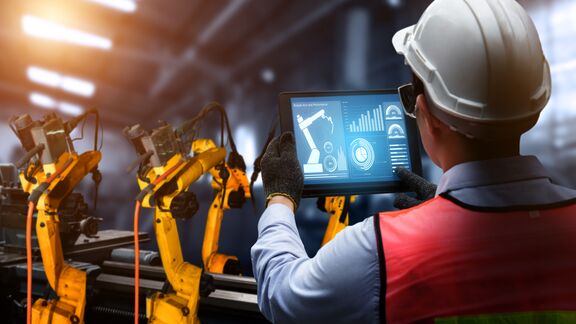
On the heels of Forvis Mazars’ survey findings pointing to resilient optimism in the manufacturing sector, there are several growth and opportunity areas for manufacturers to consider in 2026 and beyond. While innovation, workforce evolution, cybersecurity, and supply chain pressures remain top of mind, 2026 introduces new pathways for transformation.
We’ve outlined these pathways below and will explore how these themes can help drive your business goals forward.
Digital Transformation as a Necessity
First and foremost, manufacturing faces the same question confronting today’s industries: either embrace innovation or risk being outpaced by competitors that invest in artificial intelligence (AI) and other emerging technologies. Digital transformation is non-negotiable; many of the business models we know today are outdated, and the mindset of operating as “we always have” will need to shift.
Recent data underscores an industrywide shift toward mandatory modernization, with manufacturers’ spending on digital transformation projected to reach $1 trillion by 2031, growing at an impressive 17 to 24% annually.1 We are seeing a clearer picture, where manufacturers who invest early and consistently in innovation may outperform those who take a “wait-and-see” approach. Based on a recent WSJ Intelligence CEO-level study and report, CEOs shared that their companies are not only outperforming their competition, but they are also seeing a direct link to higher profitability and business growth.2
With this in mind, it is crucial for manufacturers to foster a culture of innovation at their respective companies. Doing so can help ease into the process and forgo obstacles at the onset.
One initiative that forward-thinking manufacturers are embracing is the creation of an innovation committee. This consists of a diverse team of employees from different departments, roles, and experience levels, bringing a wide range of ideas and perspectives. Diversity of thought and experience means diversity in ideas, and the more brainstorming, the better.
These committees have a regular meeting rhythm, staying focused on trends, opportunities, challenges, and emerging technologies. They encourage open discussion and challenge the status quo, while understanding limiting factors that may prevent them from moving forward. The committee may build a 90-day action plan, prioritizing small wins over longer strategic objectives. As a whole, the group should measure and share the impact of their initiatives with the broader organization to encourage greater participation.
With an innovation committee driving digital transformation efforts, the next step is to evaluate your organization’s people, processes, data, and technology to help ensure that they can support and scale new ideas. Part of this could materialize through equipping teams with the right skills, simplifying and aligning core workflows, improving data quality and accessibility, and safeguarding that your technology stack can adapt to future needs.
By focusing on these four pillars, manufacturers can free up resources tied to outdated systems, eliminate manual workflows and the constant data hunt, and redirect efforts toward higher-value initiatives. As a result, this creates the financial and operational space to invest in automation, AI, and emerging technologies to accelerate long-term digital strategy.
Building Workforce Readiness for Digital Transformation
Today’s diverse workforce spans several generations (baby boomers, millennials, Gen X, and Gen Z), presenting both opportunities and challenges as manufacturers navigate generational differences and evolving skill requirements. The industry faces a dual reality: an aging workforce nearing retirement (taking critical institutional knowledge with them) and a growing need for employees fluent in data, digital systems, and automation.
Technology may be the enabler of digital transformation, but people remain the catalyst. Every tool, whether it be robotics, agentic AI, digital twins, or advanced analytics, still depends on human judgment to define problems, validate outputs, and scale the solutions.
In our 2026 Financial Executives Priorities Report, financial planning and analysis (FP&A) was noted as the top skill in 2025. Looking ahead, data, technology, and AI hold the top spot in 2026.
This points to the current workforce: manufacturers should either upskill workers or provide reskill training that blends operational roles with digital skill sets. This strategic push can also prepare more technical jobs for the next generation of the workforce.
In addition, building a strong talent pipeline is essential in any digital transformation strategy. Partnerships with technical schools, universities, and vendors can help raise awareness of modern manufacturing careers and help prepare future workers for high-skill, tech-enabled roles.
Cybersecurity as a Business Imperative
As manufacturers embrace digital transformation, move to the cloud, and train employees on updated systems, applications, AI, and automation, they inevitably expand their risk potential. Cybersecurity isn’t a simple IT issue; it must be a company priority for longevity.
Based on our Cyber & Organizational Resilience in Manufacturing polling insights, cyberattacks are increasingly more complex and sophisticated. The modern threat landscape includes generative AI (GenAI) applied to phishing, identity-based intrusions, advanced malware, automated reconnaissance, and automated exploitation. Thus, the evolution of threats is outpacing traditional security capabilities.
To maintain operational resilience, security operations teams must examine how to effectively respond to these evolving AI-enabled threats and consider how to responsibly adopt AI as a component of the cyber operations strategy.
Focus on Supply Chain & Tariffs – It’s a Shore Thing
Manufacturing impacts from last summer’s One Big Beautiful Bill Act (OB3) are still being realized. Even so, global trade volatility persists alongside uncertainty. Many manufacturers are looking for areas they can control, which brings about the developing shift toward friendshoring, nearshoring, and reshoring.
Friendshoring is a growing trade practice where supply chain networks are focused on countries regarded as political and economic allies.3 As geopolitical tensions, shifting alliances, and national security concerns reshape trade norms, companies are turning to friendshoring to reduce exposure to unpredictable partners and stabilize access to critical materials.
Another major driver behind this shift is the move from offshoring to nearshoring and reshoring. With supply chains becoming increasingly regionalized, shifting production closer to home or to geopolitically aligned nations reduces dependency on single-country sourcing and creates more predictable cost structures.
Digital transformation plays an essential role in helping to optimize these new trade networks. Modern manufacturers are leveraging connected data, predictive analytics, and forecasting tools to anticipate disruptions, rebalance supply flows, and maintain continuity as global conditions shift.
The Future of Manufacturing
Digital transformation, workforce development, cybersecurity, and supply chain resilience are essential to manufacturing and require strategic considerations to support ongoing growth. Manufacturers can meet the moment by fostering a culture of innovation, empowering employees with the skills needed for emerging technologies, strengthening cybersecurity practices, and diversifying supply chain strategies. Together, these focus areas help manufacturers strengthen their adaptability and stay on the path to sustainable, innovative growth in an evolving manufacturing industry.
Interested in learning more? Read the full report here or reach out to a professional at Forvis Mazars.
- 1“Digital Transformation in Manufacturing: The Complete 2026 Guide,” cflowapps.com, December 10, 2025.
- 2“Future-Ready Innovation: Strategies for 2025 and Beyond,” partners.wsj.com, January 16, 2025.
- 3“What’s the difference between ‘friendshoring’ and other global trade buzzwords?” weforum.org, February 17, 2023.