

Choosing a strong enterprise resource planning (ERP) solution begins with examining your business goals, not the product features. A disciplined evaluation can help finance leaders identify a platform and implementation approach aligned with the organization’s processes, reporting needs, industry requirements, growth plans, and emerging opportunities such as automation and AI-enabled insights. This article will explore seven questions that chief financial officers (CFOs), controllers, and finance directors should consider before selecting a new ERP solution.
Selecting a New ERP
For many CFOs, controllers, and finance directors, the decision to evaluate a new ERP system begins long before a formal software search starts.
Perhaps at your organization, the finance team spends too much time on spreadsheets, financial reports require significant manual effort, and month-end close cycles take longer than they should. Does your leadership struggle to access timely information, or has rapid growth exposed limitations in systems that once met the organization’s needs?
Whatever the catalyst, selecting a new ERP is one of the most important technology decisions a finance leader can help guide. Today’s market includes broad cloud ERP platforms and industry-specific solutions. Microsoft Dynamics 365, NetSuite, Sage Intacct, and Trimble are examples of leading solutions that may fit different organizational requirements.
Choosing the right platform is not about finding the software with the longest feature list. It is about identifying the solution that best aligns with the organization’s goals, processes, industry requirements, available resources, and future plans.
1. What Business Challenges Are You Trying to Solve?
Before comparing platforms, document the operational and financial issues creating the need for change.
Some examples are:
- Manual financial processes
- Duplicate data entry
- Heavy spreadsheet usage
- Slow month-end close cycles
- Limited reporting capabilities
- Lack of timely visibility into performance
- Difficulty supporting growth, acquisitions, or expansion
A clear problem statement gives the evaluation team a practical framework for comparing options and helps prevent the process from becoming a feature-by-feature exercise.
2. Has Your Organization Outgrown Its Current System?
Many organizations reach a point where their accounting or ERP system no longer supports the business effectively. The key question is whether the current solution can support where the organization is going, not only where it is today.
Things to consider are:
- Multiple entities, locations, or business units
- Consolidated reporting requirements
- New compliance or audit demands
- Greater workflow and approval complexity
- Industry-specific processes
- Increased demand for automation and integration
These future requirements can indicate that the organization needs a more scalable financial and operational foundation.
3. What Type of ERP Fit Does Your Organization Need?
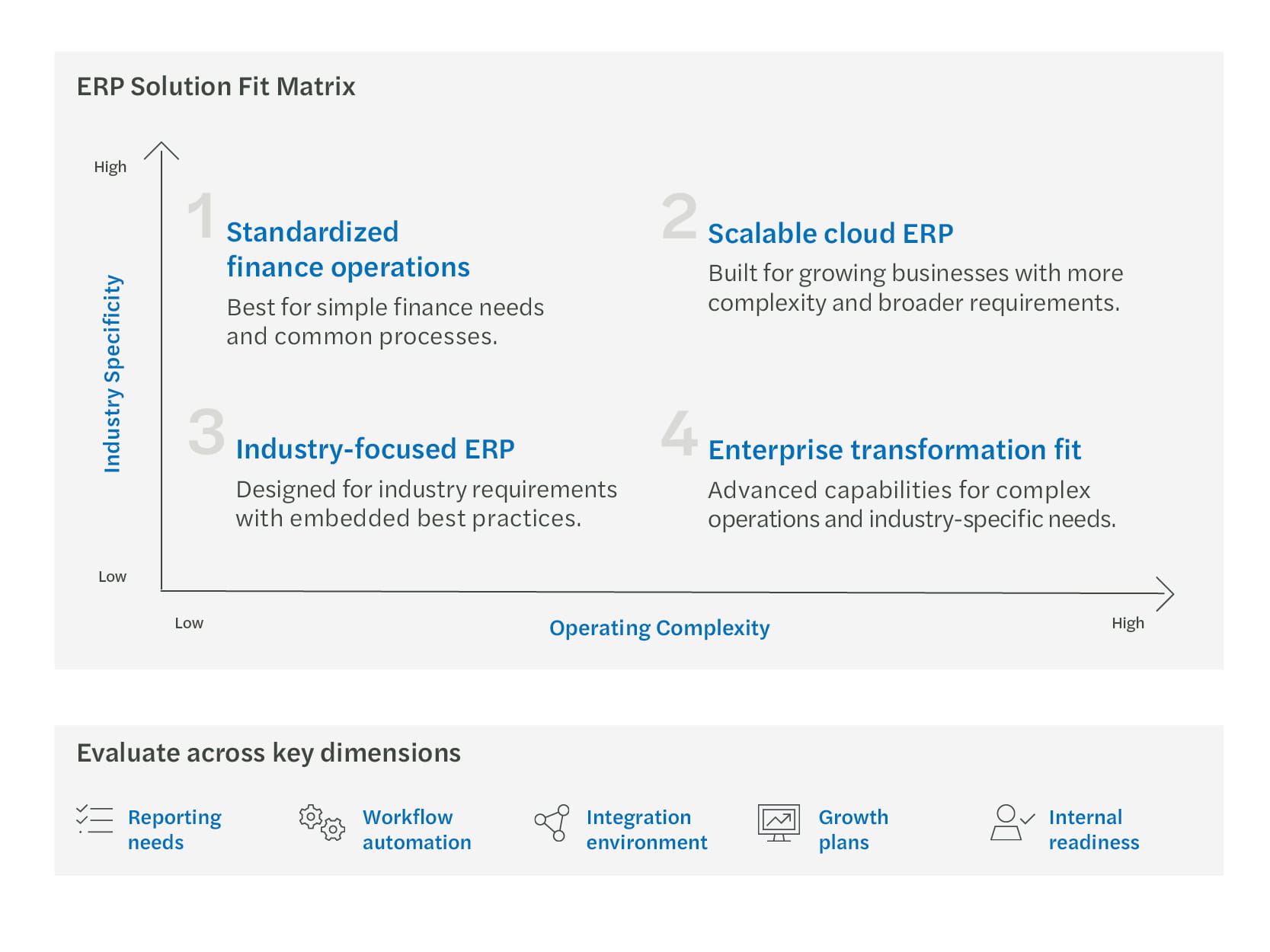
ERP selection should be guided by how well a solution supports the organization’s business model, reporting needs, operating complexity, integration environment, growth plans, and internal capacity for change. AI-assisted analysis, forecasting, anomaly detection, and workflow recommendations may be helpful considerations, and they should be evaluated in the context of business needs. Rather than comparing platforms by name, finance leaders should define the capabilities, workflows, and decision criteria that matter most to the organization.
| Evaluation Area | Common Considerations |
|---|---|
| Business model and industry needs | Consider whether the system can support the organization’s core operating model, industry requirements, compliance expectations, entity structure, and reporting priorities. |
| Financial visibility and reporting | Evaluate how easily finance teams can access timely, reliable information across departments, locations, funds, projects, programs, or other dimensions important to decision making, including where AI-assisted reporting or analysis may help surface trends more efficiently. |
| Process automation and workflow | Assess opportunities to reduce manual work, streamline approvals, improve controls, and create more consistent processes across finance and operations, including areas where intelligent automation could support routine tasks or exception identification. |
| Integration and data environment | Determine how the ERP will connect with existing systems, data sources, analytics tools, customer-facing platforms, payroll, banking, and other applications that support the business. |
| Scalability and long-term roadmap | Consider whether the solution can support future growth, new service lines, acquisitions, geographic expansion, additional entities, or changing reporting and compliance needs. |
This approach helps keep the conversation focused on fit rather than brand. A requirements-driven evaluation should clarify which capabilities, processes, reporting needs, integrations, and readiness factors are most important before the organization narrows the field of potential ERP solutions.
4. What Should You Request During an ERP Demonstration?
A generic product tour may show what a system can do, but it may not show whether the system can address the organization’s most important challenges. Ask vendors to demonstrate realistic scenarios based on your reporting, workflow, entity structure, industry, integration requirements, and any AI-enabled capabilities that could support finance or operational decision making.
Ask to see:
- Actual reporting and dashboard requirements
- Approval and exception workflows
- Multientity or multilocation management
- Automation and AI-assisted workflow opportunities
- Industry-specific processes
- Integration and data requirements
After the demonstration, evaluators should be able to explain how the platform addresses defined business scenarios, not simply whether they liked the interface.
5. Are You Evaluating the Full Cost of Ownership?
Software licensing is only one component of an ERP investment. A complete evaluation should consider the financial and operational resources required to implement, adopt, support, and evolve the solution.
Consider:
- Implementation services
- Internal project commitments
- Data migration and cleanup
- Integration and add-on requirements
- Training and change management
- Ongoing support
- Future scalability and optimization
The lowest initial price may not represent the lowest long-term cost if the organization must rely on manual workarounds, extensive customization, or an earlier-than-expected replacement.
6. Is Your Organization Ready for Change?
An ERP implementation is a business transformation initiative, not simply a software installation. Success depends on leadership, people, process readiness, data quality, decision-making discipline, and a realistic understanding of how emerging capabilities such as AI may fit into future-state processes.
Do you have:
- Executive sponsorship
- Availability of internal subject-matter experts
- Documented processes and requirements
- Data ownership and quality
- Clear project governance
- Training and user adoption planning
Readiness should be evaluated before the project begins so the organization can address capacity, governance, and adoption risks early.
7. Do You Have the Right Guidance?
The guidance supporting the decision can be as important as the software itself. An experienced ERP advisor can help the organization translate business needs into requirements, compare alternatives, identify risks, establish a realistic roadmap, and prepare for organizational change.
Ask:
- How will you learn about our organization and goals?
- How will you validate that a proposed solution is the right fit?
- What experience do you have with organizations like ours?
- Who will participate in the evaluation and implementation?
- How will you support change management and adoption?
- What support will be available after go-live?
A trusted advisor should focus on helping the organization select the solution and approach most likely to support long-term success, even when that means recommending a different platform than the one first considered.
Conclusion
ERP selection is more than a technology decision. It is a strategic business decision that can influence financial visibility, operational efficiency, scalability, and the organization’s ability to respond to change, including how it may responsibly adopt automation and AI-supported insights over time.
For CFOs, controllers, and finance directors, the strongest selections begin with an understanding of business goals first and software second. Organizations that take a disciplined approach to requirements, readiness, solution fit, and implementation support should be better positioned to select an ERP platform that delivers value beyond go-live.
Wherever you are in your ERP journey, start with a conversation.
Whether you are beginning to explore options, preparing for a formal evaluation, or trying to understand what a future ERP project may require, connecting with a solution provider like Forvis Mazars can help you ask the right questions early. Our team provides education, practical guidance, and realistic expectations around cost, internal resources, implementation timelines, and readiness considerations so your organization can plan with greater confidence.
If you have questions or need assistance, please reach out to a professional at Forvis Mazars.