

Boards are asking sharper questions, and recent data helps explain why. The C-Suite Barometer 2026 mid-year survey shows growth optimism holding at 92%, while the Confidence Index fell eight points to 35%, its lowest reading since 2021. The executive takeaway is direct. Uncertainty is the norm, and diversification across markets, supply chains, capital, and technology is the condition for growth. The U.S. picture is more bullish. Ninety-seven percent of U.S. executives are optimistic about growth, and they rank transforming IT and technology as their top strategic priority.
That gap between U.S. optimism and softening global confidence puts pressure on enterprise risk conversations. Boards want to know how vendor exposure connects to strategic risk. The pressure extends beyond the boardroom. Regulators and executive stakeholders also expect clearer visibility into third-party risk, cybersecurity, operational resilience, and AI governance. Enterprise risk management (ERM) and third-party risk management (TPRM) each hold part of the answer, often in different languages.
How Third-Party Risk Supports ERM
TPRM supports ERM by helping organizations identify, assess, monitor, and report vendor-related risks alongside other strategic and operational risks. ERM sets risk appetite and looks across the full range of enterprise risks, while TPRM goes deeper into the vendor relationships that shape several of them. The vendor-level data TPRM produces can feed an ERM dashboard, but the two programs may classify risk differently and follow different scales and reporting cycles. As a result, the ERM team may struggle to say how much of the organization’s strategic risk exposure comes from third parties. The TPRM team, in turn, may have difficulty connecting vendor risk decisions to the strategic risks the board discusses. Each program can work well on its own while the enterprise view of risk stays siloed.
Coordination can help close that gap without merging teams or collapsing responsibilities. The work centers on establishing shared language and connecting evidence, decision rights, and reporting. When those elements link up, vendor risk becomes a visible dimension of enterprise risk, and enterprise priorities help shape how the vendor program directs attention and applies risk-based tiering.
Integrating TPRM Into Enterprise Governance
Each program keeps its own focus. TPRM concentrates on vendors, monitoring, and Nth-party dependencies, while ERM concentrates on the strategic risk profile and board reporting. Integration happens in the space they share.
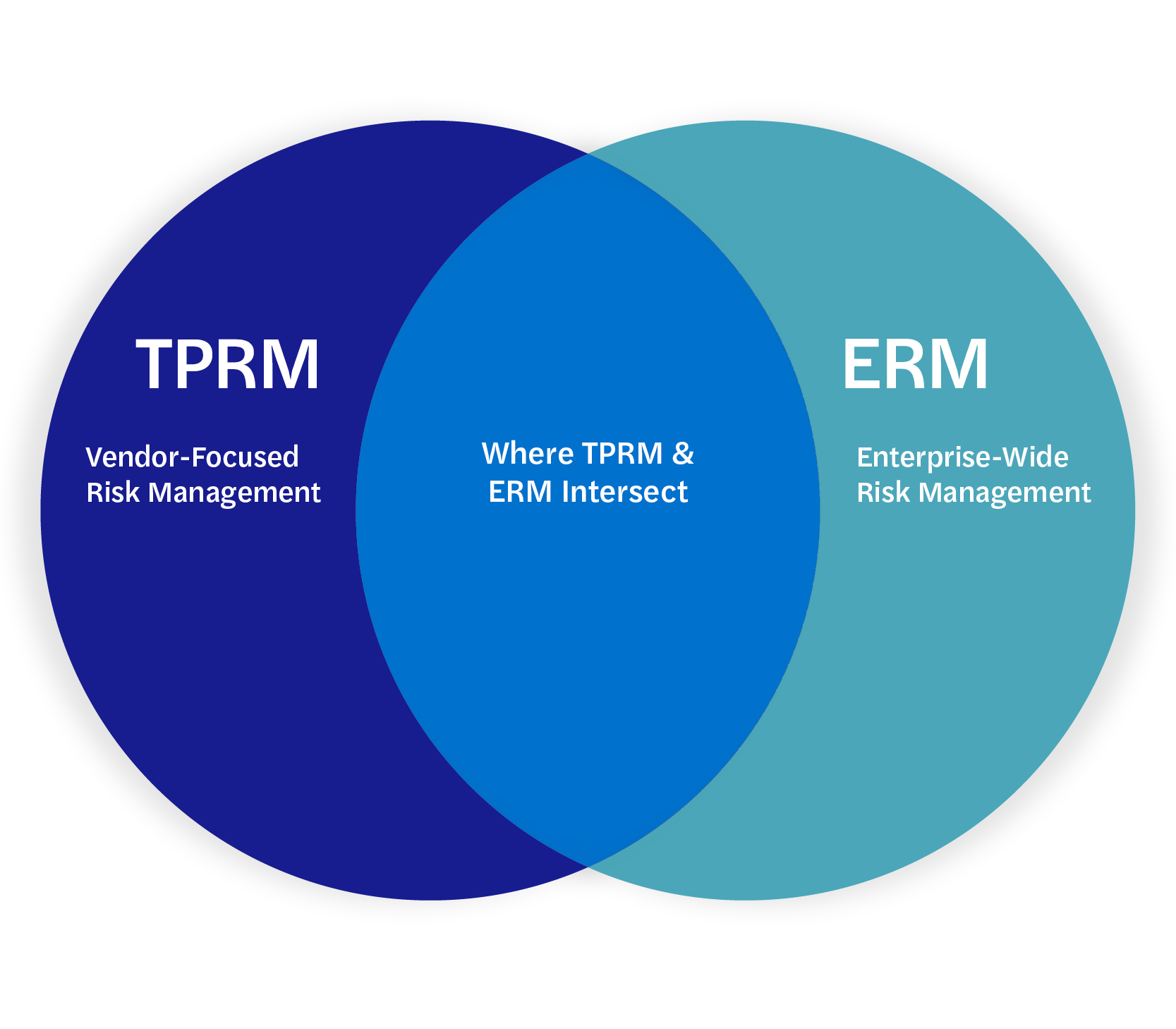
TPRM
Identifies, assesses, and manages risks from third-party relationships.
- Vendor due diligence and onboarding
- Vendor risk tiering and assessments
- Contract requirements and controls
- Ongoing monitoring and performance
- Nth-party and concentration risk
- Lifecycle management (including offboarding)
Where TPRM & ERM Intersect
- Shared risk appetite and tolerance
- Common risk language and taxonomy
- Critical/high-risk definitions and materiality
- Governance and decision rights
- Escalation and risk acceptance
- Shared data and evidence
- Integrated reporting and key risk indicators
- Concentration, resilience, and scenario planning
- Emerging risks, e.g., AI, regulatory
ERM
Looks across the enterprise to understand and manage all risks that may affect strategic objectives.
- Strategic objectives and risk profile
- Enterprise risk identification and prioritization
- Risk appetite and tolerance
- Board and executive reporting
- Cross-functional risk integration
- Enterprise resilience and scenario planning
Boards want to know what third-party exposure means for the strategic risk profile. Integration helps answer that question.
Questions for leadership: How much risk will we accept? How do we reduce it? Who is responsible?
When both programs work from the same risk appetite, agree on what counts as critical or high, and draw on accurate, shared data, leadership can answer three questions with confidence: how much risk the organization will accept, how to reduce it, and who is responsible.
Technology can support this work in several ways. Some organizations aggregate information manually from separate tools, while others share a consolidated platform across the three lines or combine commercial and in-house capabilities. Each model can work when the definitions, governance, and reporting behind it are shared.
Where TPRM & ERM Drift Apart
Many integration challenges trace back to a handful of issues:
- Different taxonomies. TPRM tracks control-level risks by category, while ERM tracks strategic risks by objective. Unless the two are mapped, their views cannot be aggregated.
- Fragmented ownership. TPRM responsibilities often span procurement, cyber, compliance, and business functions. Without clear governance, decisions can become decentralized, leading to inconsistent oversight and accountability.
- Data quality gaps. Vendor data often sits in multiple systems with inconsistent definitions, which makes it harder to roll up risk into a unified enterprise view.
- Disconnected reporting and oversight. TPRM produces continuous data, while ERM often reports quarterly or annually. Findings and priorities may also go to separate committees with no shared forum for material vendor issues, so the two views can drift out of sync.
- Limited dependency visibility. Organizations may know their direct vendors but lack sufficient insight into critical subcontractors, shared cloud providers, data centers, geographic dependencies, and other Nth parties that can lead to enterprise exposure.
- Emerging technology use. Vendor use of AI adds another layer. FINRA’s 2026 oversight report points to assessing third-party GenAI use as part of vendor due diligence for member firms, a signal of where scrutiny may extend in other sectors.1
A defined integration plan, executive sponsorship, and a realistic timeline for aligning governance, risk definitions, data, and reporting can help address these issues.
A Real-World Example: Integrated Health System
Professionals from Forvis Mazars supported an integrated health system whose ERM and TPRM programs were strong but operated independently. The audit and compliance committee had asked how third-party risk factored into the organization’s strategic risk profile, particularly for clinical systems, revenue cycle vendors, and cloud-based analytics platforms tied to patient care and reimbursement. Leadership could not yet offer a defensible answer.
Our professionals assisted the client with mapping the TPRM taxonomy to the ERM program, defining aggregation rules, and setting up a joint reporting cadence with a shared committee touchpoint. The first integrated risk management report showed the committee how vendor risk contributed to each strategic risk category. It also surfaced two areas where vendor concentration carried material implications that hadn’t been visible before, including a downstream analytics dependency supporting quality reporting. The organization reached that clarity by connecting its existing programs, with no overhaul of either.
The Role of Governance
Integration depends on governance that’s clearly defined and documented, including:
- Decision rights. Who approves material vendor risk decisions, who escalates them, and how does escalation connect to the ERM committee?
- Committee structure. Which forums receive integrated reporting, and how do vendor-related items reach the agenda?
- Roles across the three lines. How do business owners, risk and compliance, and internal audit each contribute?
- Cadence. How often is integrated reporting produced, reviewed, and refreshed?
How Forvis Mazars Can Help
As teams strengthen their programs and work toward a coordinated approach, these steps offer a starting point:
- Assess the current relationship between TPRM and ERM, including risk terminology, governance, and reporting.
- Define a target state that fits the organization’s size, complexity, and risk profile.
- Map TPRM risk categories to the ERM taxonomy and set aggregation rules.
- Calibrate risk appetite and thresholds across both programs.
- Establish coordinated governance with shared committee touchpoints and defined escalation paths.
- Build a reporting cadence that can give leadership a unified view of enterprise risk.
Our IT Risk & Compliance and broader Consulting teams can help organizations connect TPRM and ERM in a practical and scalable way. Whether your goal is to link vendor risk activities to enterprise risk objectives or strengthen third-party risk governance and reporting, we can help you move forward with confidence.
Connect with us today to take the next step in strengthening your third-party and enterprise risk programs.
- 1“Third-Party Risk Landscape,” FINRA.org, 2026.