

When it comes to strategic academic planning, you’re likely to have many strong ideas emerge from the visioning phase. Once you let go of constraints, the possibilities are (hopefully) endless. A long-range vision for the future, grounded in solid efforts to anticipate an evolving operating environment, is key for a robust strategic plan.
However, there is a reason you shouldn’t stop the process at visioning. Many higher education strategic plans have significant limitations, such as:
- The plans are finalized as a wish list of everything everyone at the institution could want or need, e.g., they’re not a prioritized and refined strategy with defined, organized milestones.
- A published plan isn’t always tied to institutional resources, e.g., it isn’t a budgeted, validated path forward.
In this edition of our Strategic Planning series, we explore the best practices for validating and prioritizing your objectives and translating them into a roadmap for accomplishing your shared vision.
Understanding the Academic Strategic Planning Process: Phases Three & Four
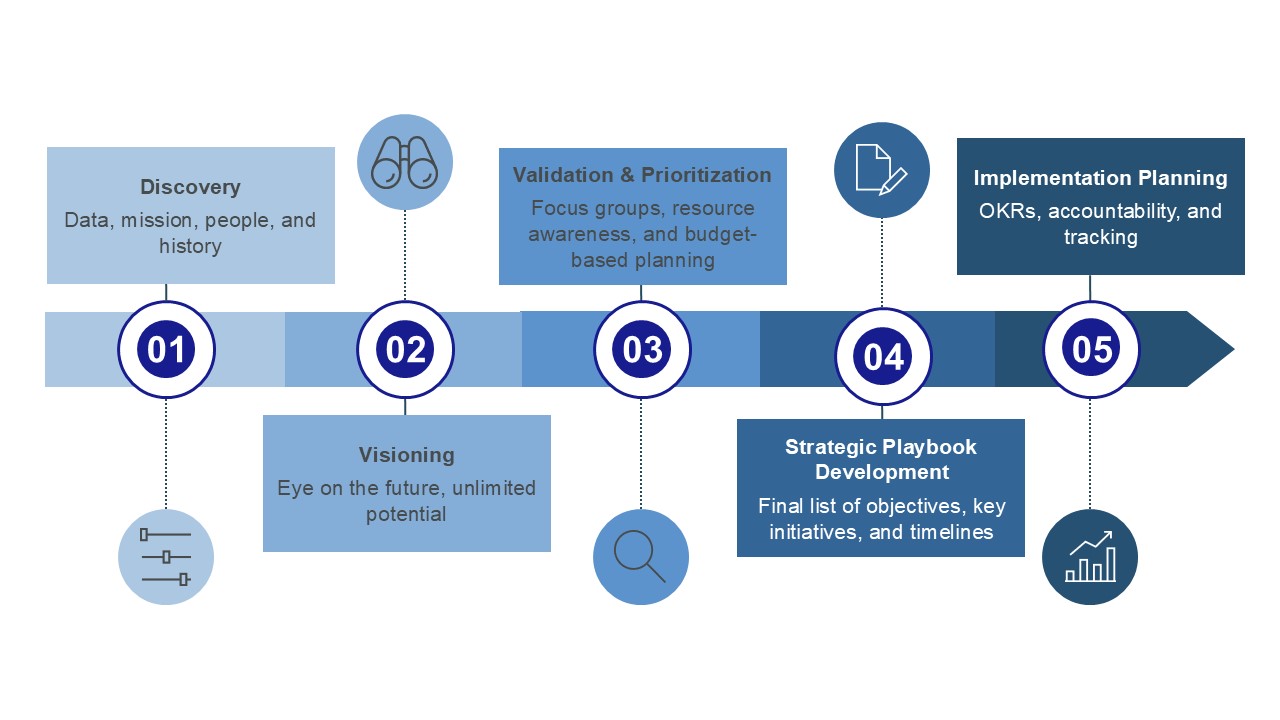
Phase Three: Validation & Prioritization
The validation and prioritization phase of strategic planning should be about translating the outputs of an ambitious visioning session into a narrow set of attainable objectives (and by attainable, we don’t necessarily mean “safe”). It’s also an opportunity to validate the vision with a broader group of constituents and align it with the institution’s resources. Here are a few questions to ask during this process:
How do we stay focused on strategy while engaging campus constituencies in important prioritization activities?
- How can we communicate the important role campus components played during the discovery phase and how that role contributed to the shared vision? How do we build excitement about initiatives without overpromising?
- How do we help our people think strategically so that we can effectively prioritize objectives?
- How can we get quality feedback on our emerging strategic plan from these constituents? A survey? A set of well-facilitated focus groups? When should this occur?
How do we identify potential costs (financial, reputational, mission, and otherwise) for those objectives that emerge as clear priorities?
- Should we develop a pro forma budget or set of financial statements?
- How do we account for best- and worst-case scenarios for elements such as enrollment and expenses that may limit (or enable) some of our activities?
- How do we determine whether initiatives are accretive?
Who determines which objectives will move forward in the planning process?
- When are those objectives communicated to the campus community?
- Who will communicate the emerging plan to the campus community?
- How will particularly negative or pessimistic feedback be received and handled during this phase?
Phase Four: Strategic Playbook Development
Phase four takes your final set of strategic objectives and begins to operationalize them into specific strategic initiatives. Based on our experience, we expect that each high-level strategic objective will require three to four strategic initiatives to accomplish it. We also expect this to vary depending on the nature of the plan. Again, the final plan should have a narrow, not broad, focus. You may end up with just one highly strategic and heavily prioritized objective. In that case, the objective should demand the bulk of the institution’s available resources and lead directly to the institution’s continued success or turnaround.
Your final objectives should be time-limited as well, making it much easier to hold yourself accountable for accomplishing them and also more compelling. For instance, if one of your objectives is to become an R1 institution, it’s very energizing to the stakeholders when the objective is framed as something that will happen “within five years” rather than “someday.”
If the objective cannot be attained in a defined time period, it may be appropriate to revisit that objective and revise it to something more focused, on your way to the “bigger” objective down the road. In the example of seeking R1 status, a more realistic five-year objective might be to focus exclusively on awarding more doctoral degrees. This approach allows you to focus on one thing, rather than spreading your resources to items like research spending, which may not be in the budget yet. Of course, the information acquired in phases one through three should inform playbook development and drive your answers to these questions.
How Forvis Mazars Can Help
Ready to launch and execute a strategic planning process that helps you prepare for what’s next? Whether you’re planning for growth, tackling day-to-day challenges, or seeking to elevate your institution’s impact, our knowledgeable team is ready to help you thrive. For more information, explore our Higher Education Consulting resources or reach out to a professional at Forvis Mazars today.
Strategic Planning Booklet
Helping you prepare for what’s next.