

Higher education institutions can produce impressive results by maintaining strong graduation and retention rates, delivering high-earning employment prospects for their graduates, and excelling in flourishing endowments. Some of these outcomes are driven by luck, reputation, or a combination of both. However, for many institutions across the U.S., there’s a rather explicit disparity between goals (or necessity) and performance. Consider that this isn’t a deficit of value, people, or resources, but instead, it’s a deficit of strategy. Higher education entities should consider pivoting their perspective and, primarily, pivot away from setting key performance indicators (KPIs) and toward setting ambitious, forward-looking objectives.
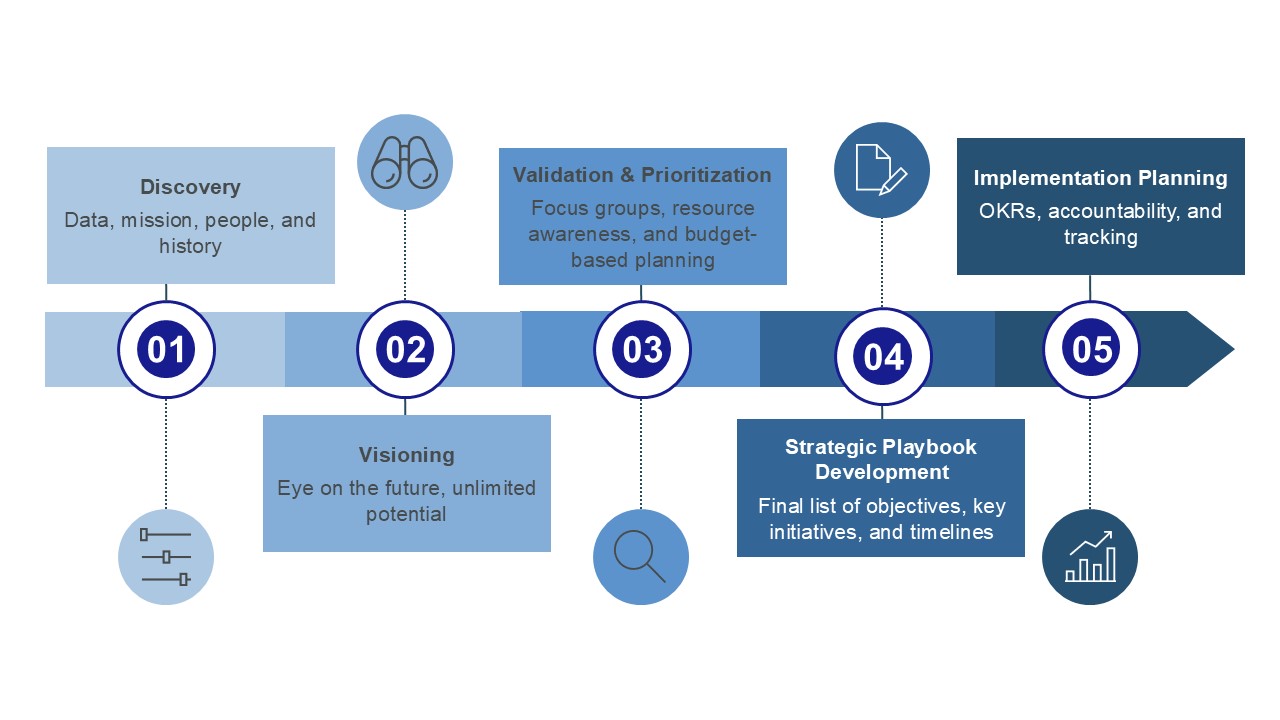
In this edition of our strategic planning series, we focus on the first two phases of strategic planning and share some best practices from our time in the field.
Strategic Planning Phase One: Discovery
The discovery phase of strategic planning should be the most straightforward. In this phase, an institution should collect internal information and external perceptions about the institution. It’s an important distinction. Institutions should self-evaluate, including taking an inventory of how others in the internal environment and the external environment view you. You can do this through a combination of data pulls, interviews, focus groups, surveys, and environmental scanning. This is an essential step in understanding your culture, and it’s even more critical to understanding potential weaknesses or threats to your operation.
You might have recognized two words in that last sentence. Discovery is also where a traditional SWOT (strengths, weaknesses, opportunities, and threats) analysis occurs. A strong facilitator can help you distinguish between these elements at your institution, but the gist of it is that strengths and weaknesses are internal, and opportunities and threats are external.
One mistake often made in strategic planning is too much focus on internal aspects. Remember, strategy isn’t about doing things better—which is what we do when we’re trying to meet an internal benchmark—it’s about achieving a long-term advantage. Such an advantage requires you to look externally, just as a good political candidate needs to understand the zeitgeist, voter demographics, and economic realities of the next election year. Of course, this may require a paradigm shift that can be challenging. But it can also be exciting.
Strategic Planning Phase Two: Visioning
A good strategic plan acknowledges that change, even necessary change, is hard. In this phase, your goal is to get your team energized about your institution’s ideal future state, so that you can move from simple planning into strategic planning. You might start by evaluating your readiness for transformation. What are the organization’s barriers to change? What do you expect to be particularly hard, and how do you build a strategy that anticipates and responds to those barriers? The desired resolution to this process is a shared commitment to design driven by identifying your purpose for action. In other words, why do things need to change, and what will guide us as we lean into our ideal future state? There are several philosophies and approaches to doing this. Our proprietary visioning methodology, for instance, is designed to elicit answers to these questions.
After some consensus on purpose is reached and a plan for change is initiated, it’s critical to imagine the ideal, boundless future state. At Forvis Mazars, we call this “blue sky visioning,” but the name isn’t important. This process requires the institution to let go of today and focus on imperatives of the future. Is your current financial path unsustainable? Are you anticipating demographic headwinds that aren’t compatible with your operating model? Do you have a particular strength that positions you well for opportunities in the future? Visioning kickstarts the creative process by challenging the institution to think without constraints. In this supercharged brainstorming session, all ideas are on the table, and a premium is placed on doing things differently in order to gain a strategic advantage.
In the next edition of this series, we’ll describe how you can translate that “blue sky” into a realistic and sustainable strategic plan.
If you’re ready to launch and execute a strategic planning process that prepares you for what’s next, explore Higher Education Consulting for more information, or reach out to a professional at Forvis Mazars today.
Strategic Planning Booklet
Helping you prepare for what’s next.