

The spring board meeting season for higher education is here. Some institutions are actively having difficult conversations about whether to remain open. Others are starting critical work to explore options for expansion or sustainability through mergers or acquisitions. At minimum, it’s the time of year when trustees get reports on strategic objective progress, plan for commencement, and review the budget for the next fiscal year. Further, there are several important decisions that must be made during this season.
Strategic Questions for Board Trustees to Ask
We have found that more boards are asking strategic questions, and there are good reasons for it. For one, the challenges to the operating model are nearly ubiquitous, even for financially healthy institutions. In addition, news of college closures is in the headlines more frequently, and it’s hard to ignore. During this critical time in the industry, it’s important for boards to understand their fiduciary duties. College and university trustees are ultimately responsible for safeguarding financial resources and can be personally liable for financial damage to students, donors, bondholders, and employees. For this reason alone, boards should always be asking strategic, and sometimes difficult, questions.
We encourage all trustees to have a basic understanding of the institution’s academic portfolio, especially at tuition-dependent institutions or those with smaller endowments. The academic operation is the institution’s primary source of revenue and primary source of expense. This makes it particularly critical to the institution’s financial health. In addition to understanding the academic portfolio, we emphasize the importance of board members asking questions about margins generated by the academic portfolio. These margins are a key indicator of how sustainable the institution’s operating model truly is. If margins are low, e.g., under 35%, it can mean that the primary source of revenue is not generating enough margin to subsidize critical functions that are not revenue-generating, such as:
- Academic advising
- Counseling for students
- Accreditation and institutional reporting
- Enrollment management
- Compliance and Title IX
- Library staffing and inventory
- Advancement and fundraising
- Career services
- Student life, including clubs and organizations
As a rule of thumb, we recommend that most nonprofit institutions have academic portfolios that (in the aggregate) generate at 50% to 70% margin. In other words, revenue left over after paying for direct expenses to run the academic operation should be 50% to 70% of the net tuition revenue. This number is not set in stone. It depends on how many other revenue sources an institution has and how complex the institution is as a whole. Institutions with larger endowments won’t need their direct margin to be as high, nor will institutions with substantive and reliable state appropriations. Boards should know this number for their institution, and they should understand how the number compares across similar institutions. Only with this information can boards truly understand whether their core operation is sustainable and charge leadership with identifying levers that will make it more sustainable.
Strategic Tools to Help Guide Board Members
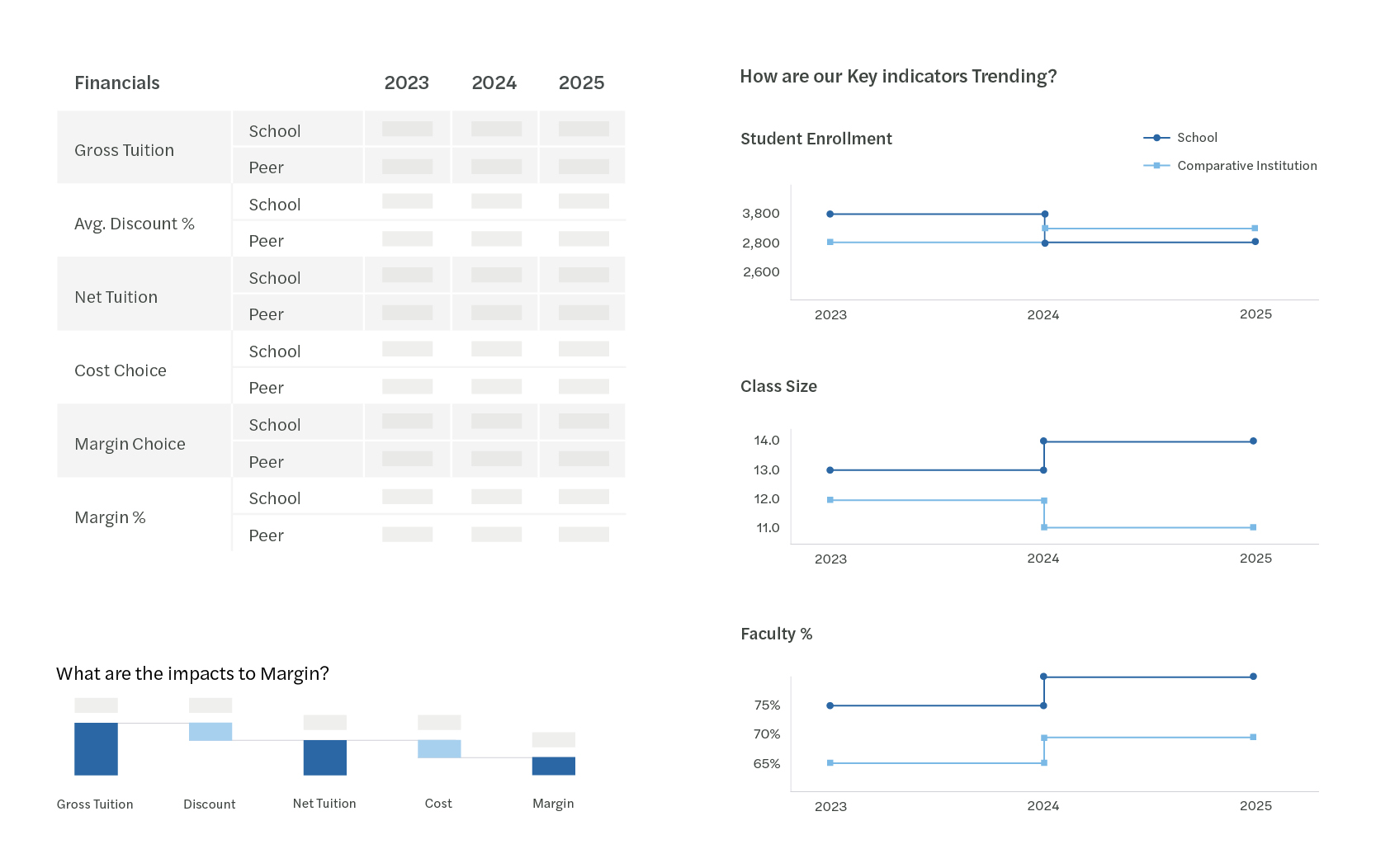
Using tools like Program Economic Analysis (PEA) can help leadership teams and boards visualize and readily understand margins within an academic portfolio. Boards may start the analysis at a high level (pictured below) before charging leadership teams with a deeper dive to understand which programs present the biggest risks to sustainability.
In addition, it is a good practice for all board members to review guidance on their role in managing the institution’s financial resources, including where they may and may not be liable to students, donors, and employees of the institution. Members of the Association of Governing Boards of Universities and Colleges (AGB) can access their statement on fiduciary responsibility on their website.1
How Forvis Mazars Can Help
Looking to strengthen board-level conversations around academic programs and strategy? Request a demo with our Higher Education Consulting team today to explore how PEA helps institutions and their boards visualize financial performance across the academic portfolio.
- 1“AGB Board of Directors’ Statement on the Fiduciary Duties of Governing Board Members,” agb.org, August 1, 2015.