

Many organizations want to gain efficiencies by accelerating or automating tasks such as bank reconciliations, accounts payable entry, budgeting, account reconciliations, and reporting. Microsoft Power Platform provides powerful tools that can be leveraged in many organizations, including the public sector, to further hyperautomation. This article defines and explores hyperautomation and provides examples of how it can be used in the public sector.
Addressing Headwinds & Challenges in Municipal Government
There are critical challenges that hinder the public sector from optimally performing services. From police and fire departments to parks and recreation divisions, animal control, utilities, and more, municipal government workers deal with inefficient, wasteful processes that take away time and resources from service delivery. This can stem from poor system integration, bottlenecks, redundancy in workflows, lack of insights, and silos.
To that end, a headwind unique to the public sector is attracting and retaining its workforce. In general, the demand for state and local public finance officers is outstripping the current supply of workers in the sector.1 The impending retirements of state and local public finance workers will further exacerbate the supply shortage,2 illustrating the need for an efficient, unburdened staff that is empowered to dedicate their time and effort toward service delivery.
Hyperautomation offers the opportunity to address these challenges by transforming tedious tasks. This process may not only help save workers hours of time, but it can also help staff operate at the highest level of resourcefulness, which is imperative to overall success.
Hyperautomation Defined
Hyperautomation is an organization-driven, disciplined approach to rapidly identify, vet, and automate business and IT processes.
Hyperautomation involves the orchestrated use of multiple technologies, including artificial intelligence (AI), machine learning, event-driven software architecture, robotic process automation (RPA), business process management (BPM), intelligent business process management suites (iBPMS), integration platform as a service (iPaaS), low-code/no-code tools, packaged software, and other types of decision, process, and task automation tools.3
Key Benefits
By automating repetitive tasks and reducing manual intervention, hyperautomation can help drive efficiency. It displaces human errors, enhancing data accuracy within financial processes. In addition, it enables staff to focus on critical thinking and value-add activities. Hyperautomation also supports scalability, enabling organizations to handle growing workloads without additional human resources. Here are four key benefits:
- Efficiency – Hyperautomation can drive efficiency in organizations by automating repetitive tasks, optimizing processes, and reducing manual intervention.
- Accuracy – Hyperautomation seeks to reduce the risk of human errors, leading to enhanced accuracy of data within business processes.
- Reallocation – Hyperautomation enables workers to focus on activities that require critical thinking to enhance overall productivity.
- Scalability – Hyperautomation can support growing workloads without increasing the number of human resources.
Finding Tailwinds: Automate High-Volume Tasks That Yield Low-Value Results
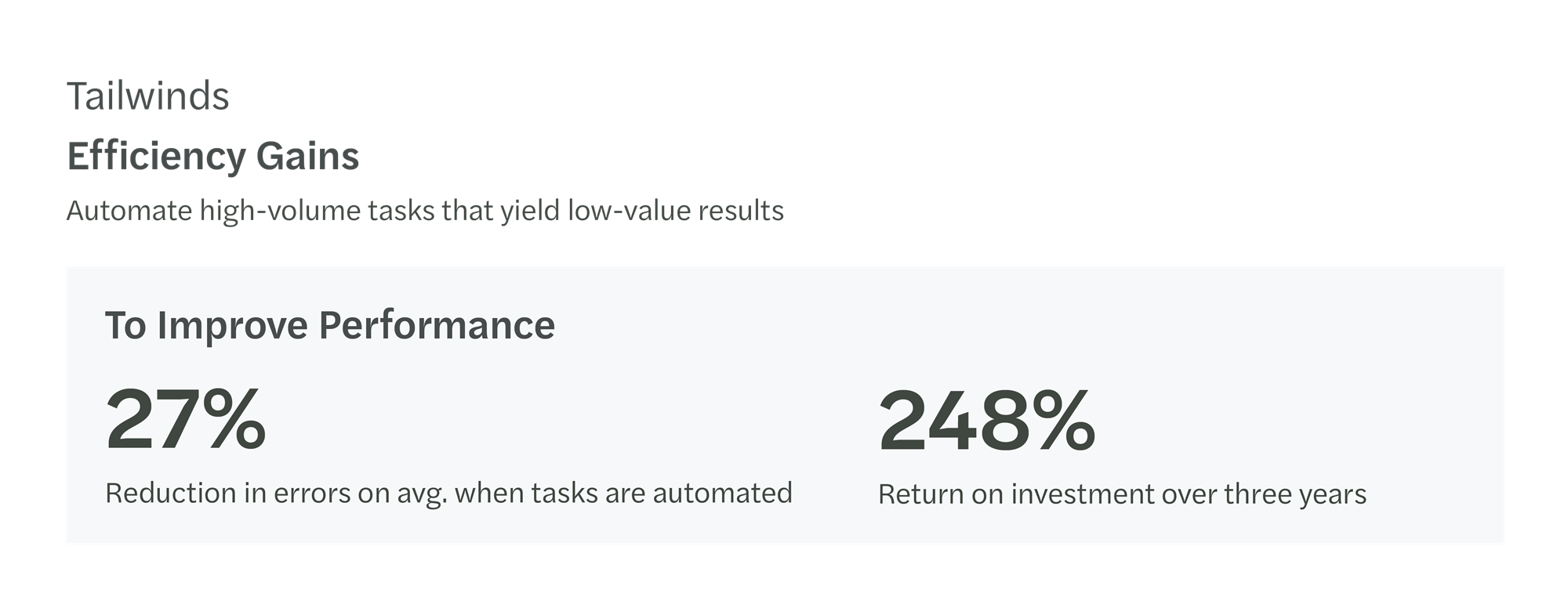
According to a recent report commissioned by Microsoft, organizations could achieve a return on investment of 248% over three years and an average reduction in errors of 27% by implementing automation for high-volume tasks.4
 Click here to open image in a new tab
Adding Hyperautomation to Your Organization
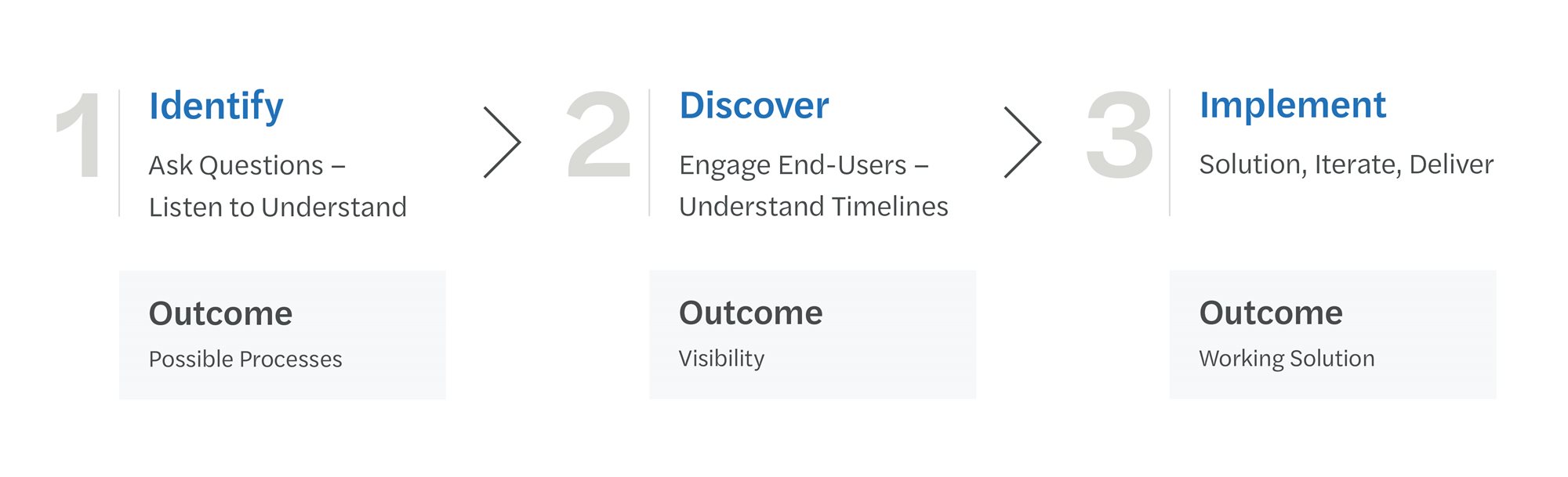
The first step in adding hyperautomation is to identify possible processes that have opportunities for automation. Once processes are identified, look to discover the viability of automation by engaging end-users to understand processes and timelines. Once a viable automation process has been determined, the last step is to implement a working solution.
 Click here to open image in a new tab
In identifying a possible process for automation, consider the following questions:
- How does the process provide value to the organization?
- Who would champion this initiative?
- Are there recurring costs associated with this process?
- What is the estimated time frame to complete this project?
- Can this automation be reused?
These questions can help guide users to the ideal processes to automate for the highest return on investment (ROI).
Examples
Accelerate Accounts Payable Data Entry
A finance department typically receives hundreds of vendor invoices in a .pdf format each month that need to be entered into the general ledger system. For this, automation tools can be used to extract data from the invoice, such as vendor name, amount, and date, and enter it into the general ledger system. It can also match the vendor’s name to the vendor’s number stored in the general ledger system. Using AI, the system can be “trained” to extract a description and expense code from the invoice, based on the vendor. This can reduce keying errors while potentially saving hours of entry time. The accounts payable department can then review the payables packet before it is submitted for approval and posting. This data can also be exported to Excel, if desired.
 Click here to open image in a new tab
Accelerate Bank Account Reconciliations
Monthly bank reconciliations can include thousands of transactions (checks, outgoing and incoming wires, outgoing and incoming ACH transactions, and other fees and deposits). A finance department needs to quickly compare and match general ledger transactions to bank transactions and then clear them in the accounting system. The goal of this process is to aggregate general ledger deposits in order to match them to bank deposits. Transactions that are not matched, due to keying errors such as transpositions, or because multiple general ledger transactions cannot be mapped to one bank transaction through automation, can then be manually investigated. By automating the matching process, employees can save hours of time that can be reallocated to the critical thinking process required for non-matched transactions.
Accelerate the Recording of Tax Receipts
Municipal and county governments receive tax receipts from several sources, frequently on a daily basis. Property taxes, hotel/motel taxes, and franchise taxes are just a few of these sources. The automation process could be triggered when emails are received with a particular subject line, such as “Spring County Tax Office.” This trigger can initiate the process to extract content from the attachments and drop them into a spreadsheet with headers such as Date, Amount, Location, etc. Data extraction can also be performed on single or multipage documents downloaded from tax offices. The spreadsheet used to collect the data can then be uploaded into the general ledger.
 Click here to open image in a new tab
Automate Report & Dashboard Generation
Frequently, a finance department needs the ability to quickly generate reports and dashboards for other departments, city managers, and city councils. This can be a laborious task. For this, automation tools can be used to pull data from the accounting system (overnight or on an “ad hoc” basis) to create a data set that feeds a PowerPoint presentation or customized dashboards and reports. This tool can bring efficiency as well as accuracy to the financial reporting process.
Conclusion
Hyperautomation provides a strategic way to help identify, vet, and automate processes to gain organizational efficiencies. This article has covered some ways that public sector organizations can explore hyperautomation to help accelerate and automate high-volume tasks. For more information, connect with a professional at Forvis Mazars today.