

Balancing Wealth Transfer With Cash Flow Needs
Estate tax planning often starts with an uncomfortable reality: many strategies designed to reduce future taxes involve moving assets out of a taxpayer’s hands entirely. In practice, that usually means transferring assets to trusts for children or other family members and accepting that both the income those assets produce and their future growth will no longer be available. For taxpayers who still rely on those assets for cash flow, this can feel like a difficult trade‑off. However, taxpayers in this position may find that while they need current cash flow from certain assets, they can strategically shift the future appreciation and the associated income tax burden to family members who are better positioned to absorb those costs. Accordingly, tax planners often look for strategies that shift appreciation for transfer tax1 purposes while deliberately managing who bears the ongoing income-tax burden.
Intentionally defective grantor trusts (IDGTs) have become a cornerstone of contemporary estate and tax planning, even though they require grantors to continue paying income taxes on assets they no longer own or receive income from. In a typical IDGT structure, assets are transferred to a trust that is designed to be excluded from the grantor’s2 estate for transfer tax purposes, while the grantor remains responsible for paying income taxes on the trust’s earnings. This intentional “defect” between income tax ownership and transfer tax ownership allows trust assets to grow without reduction for income taxes, enhancing the value of the trust for beneficiaries while allowing appreciation of the assets to occur outside the grantor’s taxable estate. These results are achieved through select powers retained by the grantor under well‑understood grantor trust rules,3 making IDGTs a widely accepted planning tool, particularly when the grantor has other sources of cash flow available to pay the associated income taxes.
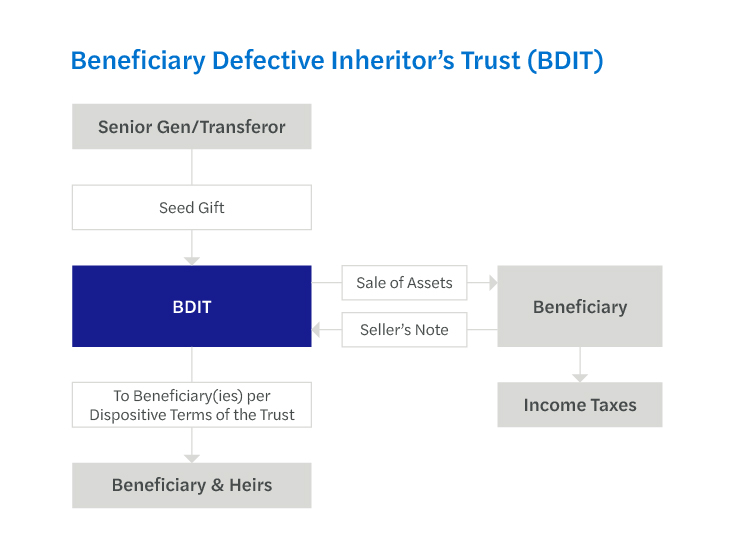
Less familiar, but conceptually related, is the treatment of trusts under Internal Revenue Code (IRC) Section 678. Rather than focusing on powers retained by the person who created the trust, §678 looks to certain powers held by another individual, most often a trust beneficiary, and attributes trust income to that person for income tax purposes. In practice, a trust subject to §678, often referred to as a beneficiary defective inheritor’s trust (BDIT), can mirror many of the economic effects of an IDGT, including taxation of trust income to an individual and continued tax‑efficient growth inside the trust, while shifting the income tax burden away from the grantor and on to a beneficiary who may be better positioned to bear that cost. Because this result relies entirely on how beneficiary rights are created and exercised, the real challenge lies in executing the structure with sufficient precision to avoid unintended consequences.
Insight from Forvis Mazars: BDIT planning exists with very little judicial or regulatory guidance, leaving few clear markers for where acceptable planning ends and unacceptable risk begins. As a result, BDIT planning rests largely upon statutory authority. Proper execution is based on reasonable interpretation of unvetted authority, meaning future challenges or interpretations in the courts or by the IRS may change BDIT planning structures suddenly. This lack of precedent and administrative guidance creates substantial uncertainty that taxpayers and advisors must carefully consider when evaluating whether a BDIT is appropriate for a given situation.
Key Benefits of Structuring a BDIT
Taxpayers may consider a BDIT as a means of achieving valuable income and transfer tax benefits by causing trust income to be taxed to the trust’s beneficiary while allowing trust assets to grow outside of the grantor’s or beneficiary’s taxable estates. When structured properly, income generated by the trust may avoid the higher income tax rates that trusts reach at relatively low levels of income and instead be reported by the beneficiary, who may be taxed at lower individual rates and, where liquidity permits, can pay the associated tax without requiring distributions from the trust. At the same time, because the trust is carefully structured to limit both grantor and beneficiary powers, appreciation in trust assets can generally be excluded from both the grantor’s estate and the beneficiary’s estate for transfer tax purposes.
Insight from Forvis Mazars: From the grantor’s perspective, a BDIT allows the grantor to complete a transfer of wealth without committing to fund the trust’s tax liability indefinitely. Once the assets are transferred to the BDIT, the grantor’s involvement largely ends, reducing exposure to future tax rate increases, changes in income, or unexpected liquidity needs that could otherwise make ongoing tax payments burdensome.
Basic Structure of BDITs
A BDIT’s structure is typically created and initially funded by someone other than the beneficiary, with a relatively small initial cash gift. That initial contribution must be a bona fide gift, with no understanding that the grantor will receive anything in return. In general, the gift amount should not exceed $5,000 or 5% of trust assets.4 The initial gift should be the only gift ever given to the trust. The trust document is drafted to give the beneficiary a short‑term (typically 30 days) right to withdraw that initial contribution, similar to a traditional “Crummey” withdrawal right. If the beneficiary does not exercise that right within the specified period, it lapses, and from that point forward, the beneficiary is treated as the owner of the trust for income tax purposes. From this point, additional assets can be added to the trust through arm’s-length sales or loans. If needed, the trust may make distributions consistent with its terms, but the structure is generally designed so that taxes can be paid from resources outside the trust whenever possible.
Advantages
- Asset protection
- Trust holds assets
- No estate tax inclusion
- Beneficiary Access
- Distributions
- Loans
Pitfalls & Practical Limits of BDITs
While BDITs can serve legitimate estate planning objectives when properly structured and administered, the technique has been subject to abuse, raising concerns and potentially inviting increased IRS scrutiny. The reality is that BDITs occupy a gray area in estate planning where statutory authority exists, but practical application has not been tested through litigation or administrative rulings. This creates genuine uncertainty that must be understood by taxpayers before engaging with a BDIT structure.
While BDITs may offer tax benefits in the right circumstances, their effectiveness depends heavily on careful design and consistent administration over time. The trust document must be drafted to grant the beneficiary enough authority to trigger income tax ownership under §678, while simultaneously limiting that authority to avoid transfer tax consequences. That balance must then be preserved through disciplined administration, including how the trust is funded, how withdrawal rights lapse, and how distributions are determined. Because the structure relies on this narrow alignment between legal form and day‑to‑day operation, small deviations can weaken or eliminate the intended tax benefits and laden the trustee of the trust with increased administrative responsibility.
By contrast, more traditional grantor‑based strategies, such as IDGTs and spousal lifetime access trusts (SLATs), often provide a broader margin for error because the income tax result flows from powers retained by the grantor rather than from carefully calibrated beneficiary rights. While those structures may require the grantor or the grantor’s spouse to remain economically connected to the trust through ongoing income tax payments, they are generally more forgiving of changes in circumstances and administrative drift over time. As a result, although BDITs may be attractive in carefully selected fact patterns, many taxpayers will prefer IDGTs or SLATs where stability, administrative simplicity, and long‑term predictability are primary planning objectives.
| Situations to Consider | BDIT | IDGT | SLAT |
|---|---|---|---|
| Who funds the trust? | Grantor makes initial gift; beneficiary sells or loans assets to the trust | Grantor transfers assets via gift or sale | One spouse transfers assets via gift or sale for the benefit of the other |
| Who pays income tax? | Beneficiary | Grantor | Grantor |
| Gift tax treatment | Initial gift plus potential gift on excess powers lapse | Gift on transfer value less note, if any | Gift on transfer value less note, if any |
| Estate tax inclusion | Excluded from both grantor and beneficiary estates | Excluded from grantor’s estate | Excluded from grantor’s and grantor’s spouse’s estate |
| Beneficiary access | Limited per trust terms | Typically, no access for grantor | Beneficiary spouse has access per trust terms |
| Administrative complexity | High – requires precise drafting and ongoing compliance | Moderate – established rules and guidance | Moderate – established rules and guidance |
| Judicial/regulatory guidance | Very limited – primarily statutory interpretation | Extensive case law and rulings | Extensive case law and rulings |
| Best suited for | Beneficiary with independent wealth who can pay tax, grantor wants to end tax obligation, multigenerational planning | Grantor with liquidity to pay ongoing tax, desire to enhance trust growth | Married couples, grantor wants indirect access |
When a BDIT May Be Right for You
A BDIT can make sense when the beneficiary’s personal financial situation fits the structure. Most often, that means a beneficiary who is financially independent, has reliable income or other personal resources, and can reasonably handle the income taxes generated by trust assets over time. BDITs tend to work best when trust income is helpful but not essential to the beneficiary’s day‑to‑day living expenses, so that the trust does not need to make frequent distributions just to pay taxes. It is also important that the beneficiary’s expected involvement with the trust aligns with the limited rights used to trigger income tax treatment under §678, not just at the beginning, but throughout the trust’s duration.
Administration is just as important as the initial design. A BDIT only works if the trust is administered in a way that respects the structure that was put in place. This includes properly tracking withdrawal rights, allowing them to lapse as intended, making distribution decisions through the trustee rather than informally at the beneficiary’s direction, and maintaining clear records of how decisions are made. For that reason, BDITs are often better suited to situations where an experienced and independent trustee is involved and where all parties understand that convenience cannot drive trust administration. If the trust is administered casually or becomes overly beneficiary‑driven, the structure can drift away from its intended tax structure. As a result, a BDIT is generally most appropriate where both the beneficiary and the trustee are willing and able to follow clear guardrails over the long term.
A practical example illustrates how a BDIT can achieve significant estate tax savings across multiple generations. Assume a parent has substantial wealth and wants to benefit their adult child who has independent income of $500,000 annually and liquid assets of $3 million. The beneficiary owns stock currently valued at $10 million with a cost basis of $8 million that is expected to appreciate significantly.
The parent creates and funds a BDIT with a $5,000 initial gift. The beneficiary receives a 30-day withdrawal right over the $5,000 gift, which lapses without exercise, establishing the beneficiary as the income tax owner of the trust. The beneficiary then sells the $10 million stock to the BDIT in exchange for a promissory note bearing interest at the applicable federal rate. Because the trust is a grantor trust with respect to the beneficiary, the sale is disregarded for income tax purposes, resulting in no capital gains recognition on the $2 million gain.
The stock continues to generate annual dividend income of approximately $300,000, which is reported on the beneficiary’s personal income tax return, while the trust makes annual note payments to the beneficiary covering principal and interest. Over the note term, the stock appreciates to $18 million. At maturity, the note is satisfied and the beneficiary has received back the original $10 million plus interest, but the $8 million of appreciation has occurred inside the BDIT and is excluded from both the parent’s estate and beneficiary’s estate for transfer tax purposes.
| BDIT Status | Estate Value | Estate Tax (40%) | Estate Tax Savings |
|---|---|---|---|
| Without BDIT | $18 million | $7.2 million | None |
| With BDIT | $10 million | $4 million | $3.2 million |
Assuming a 40% estate tax rate, this structure has saved approximately $3.2 million in estate taxes on the appreciation that would otherwise have been includible in the beneficiary’s estate if the stock had been held individually.
How Forvis Mazars Can Help
Our family office team at Forvis Mazars can help you gauge whether a BDIT is the right fit for your goals, balancing potential tax benefits with practical considerations and long‑term sustainability. We can work alongside you and your legal advisors to help design, implement, and monitor planning strategies that align with your objectives, providing clarity and confidence throughout the decision‑making process. Contact us today to learn more.
Forvis Mazars Private Client services may include investment advisory services provided by Forvis Mazars Wealth Advisors, LLC, an SEC-registered investment adviser, and/or accounting, tax, and related solutions provided by Forvis Mazars, LLP. The information contained herein should not be considered investment advice to you, nor an offer to buy or sell any securities or financial instruments. The services, or investment strategies mentioned herein, may not be available to, or suitable, for you. Consult a financial advisor or tax professional before implementing any investment, tax or other strategy mentioned herein. The information herein is believed to be accurate as of the time it is presented and it may become inaccurate or outdated with the passage of time. Past performance does not guarantee future performance. All investments may lose money.