

Life sciences leadership approaches 2026 with robust optimism and a definitive mandate: technology transformation remains the paramount strategic focus across U.S. organizations. With artificial intelligence (AI) fundamentally reshaping decision making and operational models, the results of the C-Suite Barometer from Forvis Mazars highlight the transition from strategic planning to operational execution.1,2 This article shows that executives are looking forward to the good things on the horizon, but there are headwinds that must be faced along the way. In helping you prepare for what’s next, we’re sharing five frequently asked questions we have encountered.
1. Is Sector Optimism Rising or Stabilizing?
“Despite a slight dip in revenue growth in 2025, 92% remain optimistic about their company’s growth outlook.”
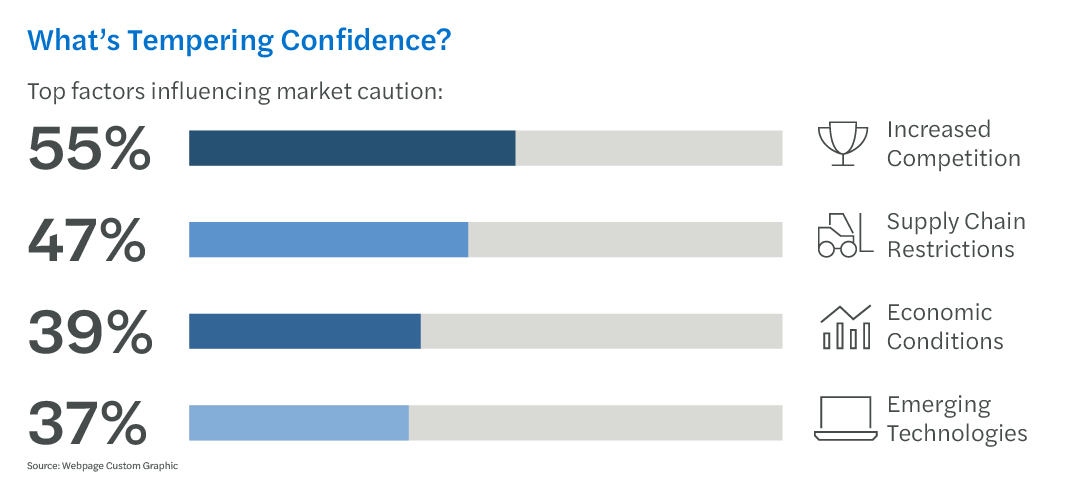
The life sciences and pharmaceutical sector viewpoint from the report shows that most leaders (96%) reported growth, with a clear majority also reporting growing revenues, 11 points higher than others globally. The top factors holding back growth for C-suite executives were increased competition (55%) and supply chain restrictions (47%). But other constraints, such as economic factors, were identified as having the biggest impact on businesses by 39% of leaders, with 37% viewing the emergence of technologies as significant. To offset potential impacts, two in three firms in the sector (67%) are boosting investment, averaged across all business activities.
Across the life sciences sector within the U.S., this pullback in certainty is linked to several potential causes. The continued uncertainty around tariffs has drug manufacturers scrambling to either source within the U.S. or consider building new facilities within the United States. Tariffs have impacted medical device companies, causing confusion at ports about which tariffs to apply. The life sciences aren’t immune from geopolitical implications either.
Another concern is the changes in leadership at the U.S Food and Drug Administration (FDA). Since early 2025, many senior leaders have left the FDA, and there has been a reduction in the workforce overall that followed. These changes, along with a limited understanding of how the federal government will view vaccines, including those with mRNA technologies (using messenger RNA to produce an immune response), create uncertainty about investment in vaccine trials. These are only some of the more obvious concerns the industry is facing. So, while a majority of respondents reported feeling optimistic despite these challenges, the number is trending down in a noteworthy way.
2. What Is Driving Growth Expectations in 2026?
It is apparent from the myriad commercials that pop up while streaming a show or scrolling through social media that drug companies are promoting GLP-1 drugs. One innovation in the area of GLP-1 drugs is the transformation from syringe-based to oral-based delivery methods. While there was some initial hesitation on the part of some digital and telehealth platforms to prescribe GLP-1s, Novo Nordisk® and Hims & Hers, Inc. reached a commercial agreement3 allowing the telehealth platform to distribute branded Ozempic and Wegovy®, ending their earlier dispute over compounded GLP-1 products. This agreement and others potentially in the future will encourage companies to find more ways to make GLP-1 medications easier to prescribe and administer.
Another area of potential growth this year may be around loss of exclusivity (LOE) for some key moneymakers. Larger companies will see some of their most profitable medications go off patent in the coming years. These companies will need to fill their research pipeline with later-stage candidates that will come to market sooner rather than later to maintain revenue growth. This will drive merger and acquisition (M&A) activity. However, macroeconomic uncertainty about interest rates may impact the willingness to make investments or to engage in M&A activity.
3. How Are Life Sciences Leaders Adopting AI?
Our C-Suite Barometer found that nearly 70% of U.S. executives reported that AI is delivering a substantial impact, while 90% have realigned organizational structures to facilitate AI implementation. For the life sciences sector, where innovation velocity and precision are critical, AI is establishing itself as a foundational capability.
Leaders are feeling cautiously optimistic about AI adoption. The use of AI is accelerating drug development. Some companies are reassessing where AI fits within their development pipelines, redirecting investment toward AI‑enabled capabilities for drug development.
Given the uncertainty around vaccines, innovative technologies, and the federal government’s approach to approving new drugs, it’s no surprise that drug companies are considering diversification. Leaders should be clear about the problem they’re trying to solve and then assess whether AI is the right enabler to apply it in a way that can be scaled, governed, and tied directly to measurable value.
In addition, many drug companies, not unlike most U.S. businesses, are adopting AI tools for streamlining internal operation processes, such as accounting and supply chain. However, many still have a cautious approach to using AI in the clinical trial process. Reducing administrative spending may free up resources for a company to invest in research and development (R&D), built internally or acquired from third parties, to make a bigger impact.
4. How Are Companies Balancing Cost Control With Innovation?
The current administration has encouraged businesses to build and manufacture within the U.S., but interest rates, confusion around FDA approval, and the administration’s trade policies have companies working to balance costs and disparate and often contradictory data points. The costs of tariffs have been high, and there is a high level of uncertainty about how long they may last and their long-term impact on supply chains. Keep in mind that supply chains can include the equipment to manufacture or package medicines or medical devices. So, moving manufacturing to the U.S. doesn’t solve immediate or medium-term supply chain concerns.
However, the One Big Beautiful Bill Act (OB3 or OBBBA) has provided companies with the opportunity to expand manufacturing operations through the immediate expensing of equipment and new manufacturing plants built through 2030. OB3 also provides for full expensing for R&D costs starting in 2025, which further supports growth in innovation in life sciences. The expensing of equipment is allowed for building a plant in the U.S., and eligible R&D costs must be U.S.-based R&D costs, not foreign, as those costs must still be capitalized.
5. What Strategic Priorities Are Emerging for the Next 24 Months?
While no one can predict the future, life sciences companies can keep their focus on specific strategic priorities for the next few years. Some of the basics include managing existing portfolios and coping with LOE by advancing high-quality candidates through the pipeline. Companies may consider M&A activity to strategically boost return on investment (ROI), advance IP, and backfill pipelines. Hopefully, there will be clear guidelines on the future of vaccines. Companies must adapt and respond to current evolving federal policies regarding vaccines, drug trial approvals, and working with direct-to-consumer retailers.
There is still room to grow and optimize GLP-1 derivatives. Again, understanding the FDA’s approval time and drug trial process will be critical here. Companies will need to keep an eye on trade tariffs and how they’ll impact where they manufacture their drugs. There are seemingly endless impacts on supply chains, including bringing in either equipment or drug compounds into the United States.
How Forvis Mazars Can Help
Economic uncertainty and intensifying competition continue to exert pressure on life sciences organizations. However, U.S. executives maintain a highly optimistic outlook regarding growth for 2026. The 2026 C-Suite Barometer indicates that leadership is bolstering technological infrastructure, risk management frameworks, and operational flexibility to maintain a competitive advantage.
Forvis Mazars can provide extensive resources to life science companies across each phase of commercialization, from pre-revenue companies seeking funding and navigating regulatory requirements to multinational pharmaceutical companies. We bring our unique skill set to collaborating with your company to help empower insightful growth, risk management, and process enhancement.