

As today’s health systems pursue strategic, aligned growth, they’re constrained by significant barriers. According to our Mindsets 2026 Healthcare Executive Leadership Report, some of the most prominent constraints include access to capital and access to staffing.
For decades, health system growth followed a familiar path: add beds, build towers, expand square footage. However, over the past several years, an increasing number of organizations have had to re-evaluate major expansion projects that have become unaffordable due to construction cost increases.
In addition, communities become frustrated by hospitals that feel “full” while still struggling financially. When hospitals go on emergency department (ED) diversion or delay elective surgeries due to throughput bottlenecks, referral and transport patterns shift, regulatory risk increases, revenue drops, and community image may be tarnished.
Together, these issues have elevated the importance of access in growing hospital capacity. While health systems struggle to fund capital projects, many have an opportunity to unlock patient care capacity that’s trapped in flow inefficiencies, misaligned incentives, and fragmented decision making. This article explores where health systems often lose capacity and how they can improve access to support aligned, organic growth.
Where Do Health Systems Lose Capacity?
Healthcare leaders often frame capacity challenges as a shortage problem, but in most systems, capacity loss is operational rather than structural. Controllable variability in patient flow is a persistent source of lost capacity. For example, when discharge decisions depend on individual physician habits rather than standardized, predictable processes, beds may become unavailable when downstream demand peaks. This can lead to delayed admissions and avoidable ED boarding that reverberates across the system.
 Click here to open image in a new tab
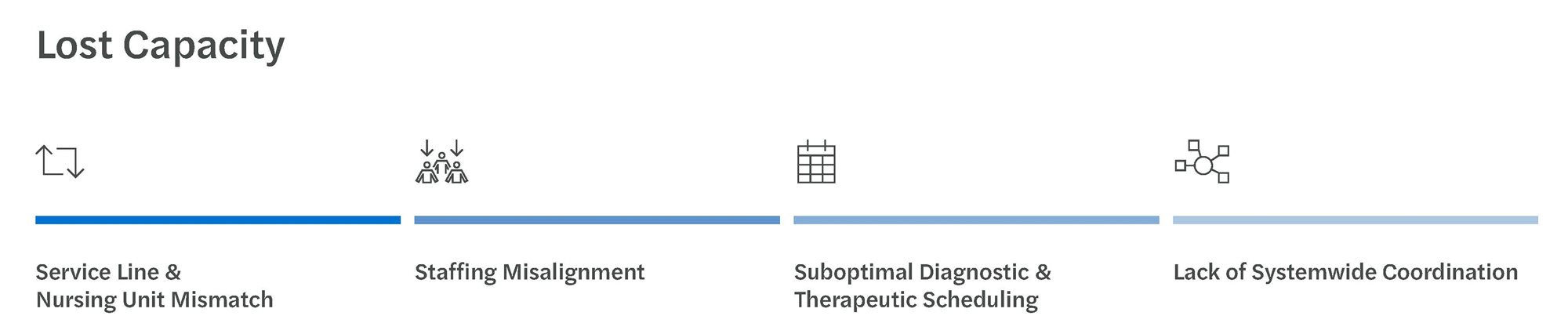
Service Line & Nursing Unit Mismatch
Capacity also erodes when strategic service line growth outpaces nursing unit configuration. To bolster revenue, many hospitals target growth in high-margin service lines, such as oncology, cardiovascular, and neurosciences, without rethinking patient cohorting or physical layouts.
For example, when cardiovascular demand exceeds the capacity of a primary 24-bed unit, organizations struggle to enable placement on other units with appropriately trained staff and adequate support space in place. This can result in lost capacity, as existing beds cannot flex to meet real demand because the right patients aren’t in the right units at the right time.
Staffing Misalignment
Staffing misalignment compounds the problem. Hourly and daily demand for healthcare is inherently uneven, yet staffing models often remain static. Failing to adjust to seasonality, weekday-weekend variation, or inter-day swings creates artificial bottlenecks that no amount of hiring can fully resolve. In these cases, labor is present, but not when or where it is needed most.
Suboptimal Diagnostic & Therapeutic Scheduling
Suboptimal diagnostic and therapeutic scheduling introduce another layer of hidden loss. For example, inadequate operating room (OR) size may restrict certain cases, e.g., orthopedic, from being scheduled in certain rooms. Block time hoarding and poor release discipline in ORs and clinic exam rooms can lead to underutilized assets during peak demand periods.
Governance structures often measure utilization of “scheduled” block time but miss analyzing overall capacity. For instance, while exam room utilization by provider may look high, this doesn’t necessarily mean that rooms are well utilized on Friday afternoons or Thursdays during grand rounds. Hospitals need additional sensitivity modeling to identify opportunities to expand operating hours or shift schedules.
Lack of Systemwide Coordination
Perhaps most damaging is the lack of systemwide coordination of capacity. Without centralized bed placement or enterprise-level visibility, hospitals miss the chance to operate as integrated systems. Health systems struggle to balance patient demand across different types of facilities, including community hospitals, tertiary and quaternary facilities, and post-acute assets.
As hospitals nationwide are seeing sicker patients, the trend is to overutilize higher-acuity facilities. Often, the overflowing flagship hospital does not decant admissions back to the community hospital, or vice versa, when poor staffing mix at the community hospital forces a transfer to the tertiary center. Decisions that may appear to be optimized locally often create delays elsewhere, particularly between inpatient units and diagnostic/treatment areas.
The throughline across these issues is that capacity management is a matter of orchestration and alignment, not expansion. Health systems that treat capacity as a shared, dynamic resource rather than a departmental asset can unlock significant throughput without building new beds or burning out staff.
How Do High-Performing Health Systems Improve Access & Capacity?
High-performing health systems distinguish themselves by how deliberately they manage access and flow at the enterprise level. They move beyond departmental optimization and treat access as a core system strategy, with leadership, governance, and performance metrics reflecting this approach.
System-Level Accountability
First, these organizations make leaders accountable for system-level flow, not just local performance. They elevate access to the same strategic importance as quality, safety, and financial stewardship. They also align incentives to enterprise metrics such as throughput, transfer acceptance, and time-to-bed, rather than siloed unit outcomes. For example, we worked with an East Coast academic medical center to help leverage its patient transfer center as a strategic asset designed to actively manage demand across the system in real time, rather than treating it as simply a call-routing function.
Physician Incentive Alignment
High-performing systems also align physician incentives with access goals, positioning throughput as a shared responsibility embedded in contracts, coverage models, and expectations, particularly in the ED, hospitalist services, and procedural areas. When physicians are incentivized to support timely admissions, discharges, and block release discipline, access may improve without compromising clinical autonomy.
Focused Predictive Analytics
Data is another critical differentiator, but not in the way many expect. Leading organizations resist the urge to overbuild analytics platforms before fully leveraging the data they already have by asking better operational questions. They use predictive analytics to anticipate bottlenecks hours or days in advance, enabling proactive staffing, bed allocation, and discharge planning.
Targeted KPIs
Equally important is how systems measure and communicate performance. High-performing systems rely on a small set of effective, action-oriented key performance indicators (KPIs) tied directly to access and throughput. Metrics such as admits per staffed bed, ED admit decision-to-bed time, OR utilization by surgeon (not aggregate), and discharge-before-noon rates linked to length-of-stay outcomes help create clarity and accountability. For example, we worked with a West Coast academic medical center where bed occupancy is regularly at or above 95%. The organization intentionally measures and prioritizes the percentage of discharges before 10 a.m. to decant ED boarders, not as a generic goal, but as a targeted system intervention.
Quantified Financial Impact of Blocked Access
Finally, high-performing organizations differentiate themselves by quantifying lost revenue due to access constraints. By making the financial impact of blocked access visible, they shift the conversation from anecdote to strategy.
How Are Executives Reframing Access as a Growth Strategy?
Health systems have traditionally framed access as an operational or patient experience concern, often delegated to the ED or nursing leadership. However, CEOs and regional executives are increasingly focusing on access, recognizing that it directly affects:
- Revenue growth and leakage
- Market share and referral loyalty
- Quality and safety outcomes
- Physician satisfaction and retention
- Community trust and reputation
Boards are noticing, too, and are now asking CEOs questions such as:
- How much growth are we forgoing because patients can’t get in?
- Why do capital requests keep rising without commensurate returns?
- Could we unlock more capacity through operational changes?
To answer these questions, health systems should revisit their operational dashboards to add key metrics such as those shown below.
Key Dashboard Metrics to Prioritize System Access
| Patient Flow Center Metrics |
|
| Market Leakage/Outmigration Volumes |
|
| Lost Revenue Attributable to Access Constraints |
|
| Deeper Analytics on Existing Metrics |
|
How Forvis Mazars Can Help Health Systems Improve Access & Capacity
Improving access inevitably challenges entrenched behaviors. It requires difficult conversations about block time, rounding practices, hours of operation, discharge norms, and cross-departmental accountability, as well as senior executive sponsorship and ongoing attention. However, health systems that invest effort in these areas can see returns in improved patient care, provider coordination, and community access.
Our facility and capital planning team at Forvis Mazars works both independently and in collaboration with architectural/engineering firms to help health systems navigate these challenges and incorporate access and facility solutions into integrated, systemwide strategic facility plans. If you have questions or would like assistance with your access and growth strategy, please reach out to our professionals today.