

Organizations face a multitude of challenges that can compromise their operational integrity and viability. These challenges manifest in a wide variety of threats, including political, market, and industry fluctuations; technological challenges; natural disasters; and disruptions from malicious actors; just to name a few. Improving resilience capabilities to potential disruptions can help organizations respond more quickly and effectively to disruptions; maintain critical operations in the face of adversity; protect key assets, resources, and personnel; and rapidly recover back to a normal operating state.
One of the most effective ways to prepare for any type of disruption is for an organization to create an in-depth organizational resilience program, which is a program that implements and sustains a range of safety, security, and risk management plans, processes, and procedures to help gauge, mitigate, and respond to risks and reduce the impact of unplanned disruptions, as well as protect its core functions, workforce, and key technology systems and applications.
An effective organizational resilience program is organized around an integrated resilience framework of four key components:
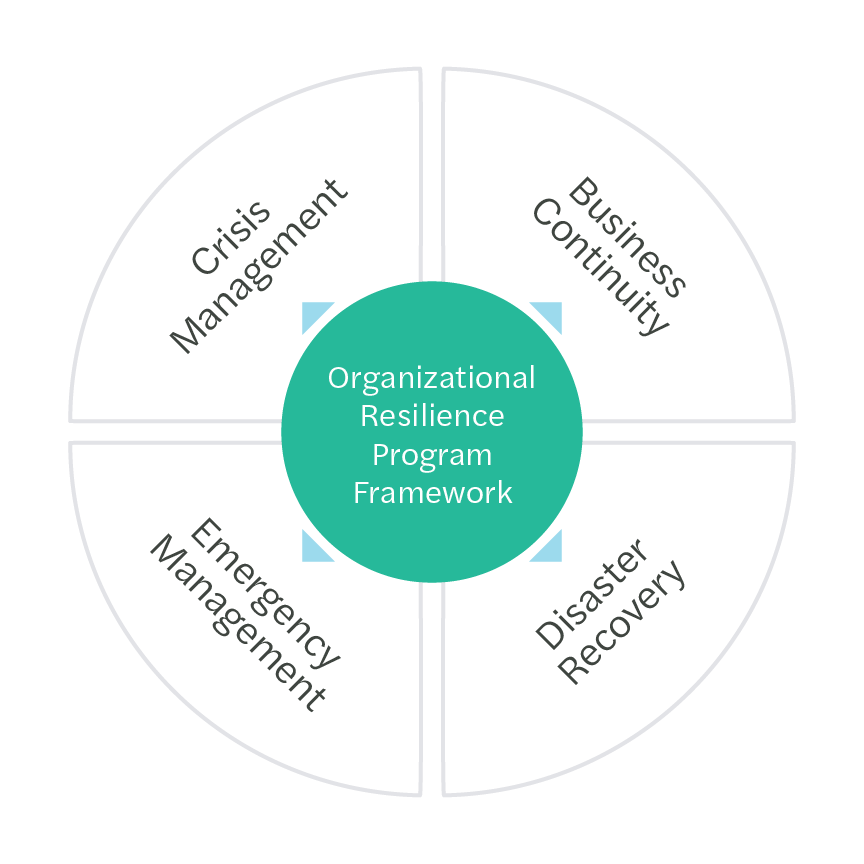
- Crisis Management
Coordinate incident response at the executive, corporate, and local levels - Business Continuity
Continue and recover critical business processes and functions - Disaster Recovery
Recover critical IT systems and applications - Emergency Management
Protect people and property
A Focus on Cybersecurity in Organizational Resilience Planning
Historically, organizational resilience planning has centered on large-scale disasters that impact operations across the whole organization, such as large natural disasters. More and more, targeted threats to technology capabilities in the form of cybersecurity threats have taken a front-row seat for business continuity and disaster recovery planning and planners. As a result, cybersecurity must play a critical role in any effective organizational resilience strategy as hacks, ransomware, and any form of targeted cyberattacks can affect an organization’s ability to operate as dramatically or worse than any natural disaster.
How Do Cyberattacks Impact Organizations?
The consequences of cyberattacks are wide-ranging and complex, and can involve:
- Data breaches exposing sensitive customer and company information
- Financial losses from theft, fines, and legal penalties
- Reputational damage harming customer trust and loyalty
- Operational disruptions leading to downtime and productivity loss
- Intellectual property theft compromising competitive advantage
- Increased regulatory scrutiny and compliance costs
- Loss of stakeholder confidence and market value
The types of planning, response, and recovery strategies used in cybersecurity have vital applications when it comes to an effective organizational resilience strategy. Making sure your organization can adapt, continue to function, and provide key services to your customers or stakeholders is a direct result of how your data is managed, stored, backed up, and protected, including but not limited to the following cybersecurity strategies:
- Cybersecurity Risk Assessment
- IT General Controls Testing
- Penetration Testing
- Ransomware Risk Assessments
- Red Team Offensive Security Services
- 24/7 Cybersecurity Managed Services
How Forvis Mazars Can Help
We can help go over and design your organizational resilience preparedness framework and program around an all-hazards approach that can help prepare your organization for numerous types of disruption. We can assist in the creation of cyber response strategies, planning activities, testing, and validation. If you have any questions or need assistance, please reach out to our cybersecurity or business consulting professionals at Forvis Mazars.