
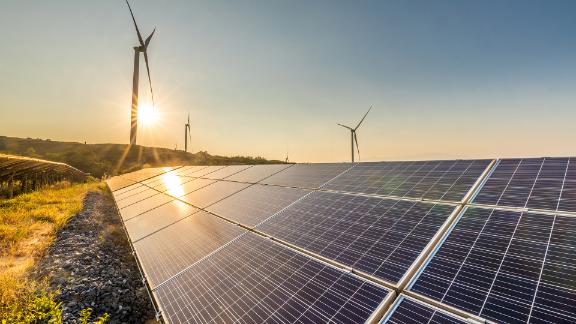
Energy conference RE+ returned to Las Vegas this year with insights for more than 37,000 registrants on topics affecting the industry. Several renewable energy team members from Forvis Mazars attended and collaborated to share key takeaways from the event. Despite the current headwinds facing the industry—including recent tax legislation impacting certain tax incentives, stubbornly high interest rates, and long interconnection queues—representative companies remained committed to providing renewable energy solutions throughout the U.S. from large developers to independent owner operators.
Developers have learned to remain nimble and flexible with shifting policies, having contingency plans and scaling solutions to get projects done. While this requires leadership to make difficult staffing and capital expenditure decisions, many organizations are learning how to operate leaner than ever before while enhancing the value received from their service providers. This article will highlight some of the key issues raised at the conference and how Forvis Mazars can assist.
Development Assets – Interconnection & Beyond
With the passage of the One Big Beautiful Bill Act (OBBBA) in 2025, certain investment tax credits (namely the Investment Tax Credit (ITC)) are no longer eligible for certain renewable energy entities. This has had a significant impact on developers, independent power producers, construction companies, and many others in the development pipeline.
Specifically, there is a broad expectation that energy pricing will increase given the strong demand for energy, which is being accelerated by many large data center projects to support cloud, artificial intelligence (AI), and other technologies. With the ineligibility of the federal subsidy for some projects placed in service, construction companies and suppliers will likely feel downward pressure on margins as developers model out projects to achieve their expected return on investment (ROI).
As a result of the ITC’s ineligibility, companies are now focusing on projects with a higher likelihood of reaching interconnection and meeting the IRS’ placed-in-service deadline, while spending less time and resources on speculative projects. In many ways, developers are getting back to the basics of developing high-quality projects while ensuring appropriate leverage via third-party debt and/or proceeds from tax equity investors. Many developers continue to prioritize cash generation through the transfer of ITCs as allowed with the passage of the Inflation Reduction Act in 2022.
In the past few years, we have observed a move from developing as many projects as possible to a more targeted approach of emphasizing the completion of projects into service to monetize the ITCs. This has been one of the most notable changes in strategy in recent years. We have also seen an expansion of renewable energy projects into the southeastern states due to continued demand from that region.
Financial Modeling
With the changes in tax laws and regulations, accurate financial modeling is critically important. Financial modeling will help guide companies to make informed decisions, manage risk, and ensure long-term project viability.
As we connected with conference attendees on this topic, several organizations have reduced the amount of internal resources in this area, given the industry headwinds. With the loss of legacy knowledge, our consulting teams have found opportunities to come alongside developers and investors to help fully outsource this function or provide specific training to team members on best practices. Companies will need to make sure their models are accurately capturing the anticipated market shifts for their projects, including interest rates, construction costs, and energy pricing, just to name a few.
We continue to see opportunities to work with companies to assist with model due diligence, which gives companies an extra set of eyes on their processes, policies, and procedures to help achieve more accurate results.
SALT Explorer
State and local tax (SALT) was a consistent topic throughout the conference. As margins get squeezed and local municipalities continue to enforce their unique tax regulations, there is strong demand for resources that address these specific needs. With more than 10,000 unique tax jurisdictions in the U.S., it can be overwhelming for organizations looking to do business in new states. We had the opportunity to connect with companies and discuss our web-based application, SALT Explorer, which features live-rate lookup for sales tax (using an address or GPS coordinates) and is updated in real time with local guidance on navigating taxes in all 50 states and related municipalities.
SALT Explorer’s goal is to help developers save time and achieve greater efficiencies in their tax research processes for bidding and tax compliance filings. SALT Explorer is available to help with a more accurate calculation of project-based tax exposure and gross-receipts calculations, along with easy access to SALT professionals at Forvis Mazars.
SALT Explorer is a prime example of how collaboration and innovation can help solve real problems that developers face daily around the country.
Networking, Community, & Shared Learning
The conference was a great opportunity for collaboration. Instead of competition, networking took precedence and reiterated the value in learning from one another. Attendees reconnected with longtime colleagues, made new friends, and shared insights in both formal and informal settings—from breakout rooms and roundtables to coffee breaks and evening happy hours.
With each visitor to our exhibitor booth and others we met throughout the conference, we were constantly reminded that relationships remain the cornerstone of any industry, and clean energy is no exception. This was evident not only for professionals from Forvis Mazars, but also other industry partners who interacted and created opportunities to help one another.
In addition, some of our colleagues attended events hosted by Solar Sisters, a nonprofit organization focused on empowering women through clean energy entrepreneurship. At RE+, their presence was designed to support community, mentorship, and empowerment for women in the clean energy industry.
Conclusion
The 2025 RE+ conference confirmed a large shift as the industry looks to move forward amid much uncertainty. In many ways, it is as simple as “getting back to the basics” for all companies regardless of size. As the industry grows more complex, the winners will be those who can harness relationships and innovation to lead the way forward.
If you have any questions or need assistance, please reach out to a professional at Forvis Mazars.