

Credit leaders across the banking industry continue to navigate a complex environment shaped by evolving economic conditions, changing borrower behavior, and emerging technology. Related to this, several common themes consistently emerged from discussions with credit executives during recent Peer-to-Peer Credit Roundtables led by Forvis Mazars. The following insights highlight key trends affecting credit risk management today and considerations for banks as they monitor portfolio performance and prepare for what lies ahead.
1. Loan Delinquency
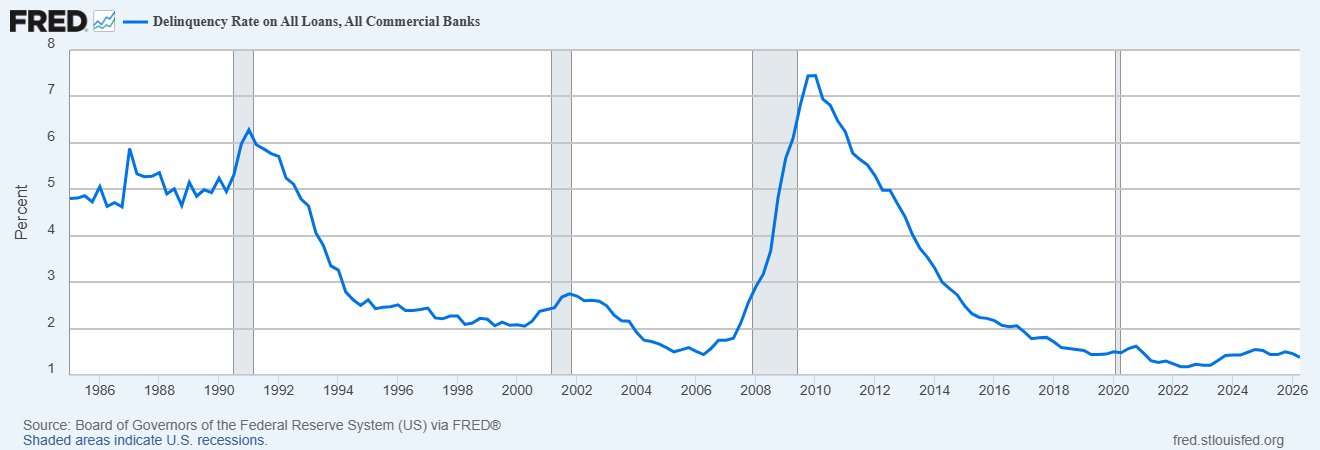
Loan delinquencies continue to slowly trend upwards across most major categories after reaching their lowest levels in almost 40 years during 2022. Those 2022 levels were likely influenced by pandemic-era government support and elevated liquidity across consumers and businesses. As shown below, the broader delinquency rate has increased from that trough, underscoring the need for continued attention to borrower performance and portfolio trends.
Source: Board of Governors of the Federal Reserve System (US) via FRED
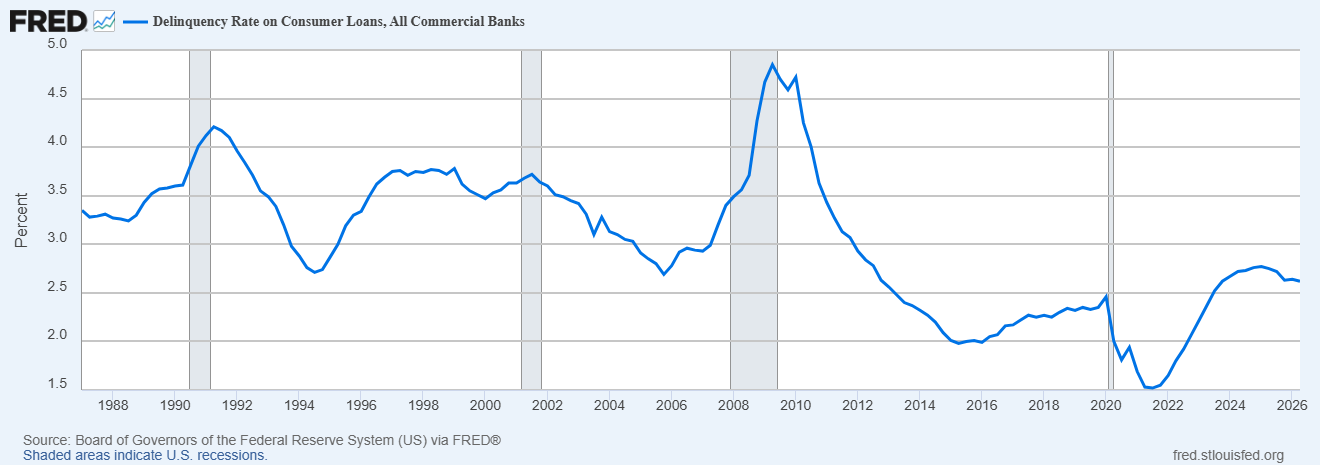
Consumer loans have experienced the sharpest recent increase, an important trend for banks to monitor given the potential relationship between consumer credit stress and future spending patterns.
Source: Board of Governors of the Federal Reserve System (US) via FRED
Although delinquency rates are increasing, they remain low relative to historical levels. The sharper rise in consumer delinquencies is worth watching, as continued pressure on consumers could signal weakening demand and broader economic stress. Forvis Mazars has also observed increasing delinquency rates across many loan review clients.
2. Problem Loan Levels
Problem loan levels are also moving higher, though they remain below prior stress periods. Our loan review team serves approximately 150 banks each year and monitors several asset quality ratios, with the classified loans-to-capital ratio serving as one of the most important indicators. This ratio declined steadily after the 2008 recession, increased modestly during the pandemic, and reached a low of approximately 9% in 2023. Since then, the average has increased to just over 12%. While we expect problem loan levels to continue increasing in the near term, current levels continue to compare favorably to historical periods of credit stress.
3. Commercial Real Estate Vacancy
Vacancy rates for retail, industrial, and multifamily properties appear relatively stable; however, office vacancy remains elevated and continues to represent a more persistent area of concern.
According to a recent Cushman & Wakefield article, overall U.S. office vacancy was 20.1% in Q2 2026, down 10 basis points from Q2 2025. The article noted that “vacancy is easing as supply-side pressures fade,” supported by a continued reduction in available sublease space. Sublease inventory has declined 28% from its cyclical peak, while new office deliveries have slowed to a 14-year low.1 The article also noted increased conversions, repositioning, and demolitions of less competitive office space.
Many Forvis Mazars client banks have experienced more stress in office-related credits over the last five years. However, exposure levels generally appear below the national average, largely because many community and regional bank portfolios have limited exposure to large central business district office buildings where vacancy challenges have been the most pronounced.
4. AI in Underwriting & Portfolio Monitoring
Few topics generated as much discussion during the roundtables as AI, highlighting the growing impact the technology is beginning to have on commercial credit risk management. Executives reported that banks are increasingly using AI to support underwriting and portfolio monitoring activities, particularly those involving large volumes of data and repetitive analysis. Common applications include financial statement analysis, document review, covenant monitoring, and the identification of emerging credit risks. Participants noted that AI can improve efficiency and enhance risk identification, allowing credit professionals to spend less time on administrative tasks and more time exercising credit judgment.
While banks continue to expand their use of AI, executives generally drew a clear distinction between using AI to support credit decisions and allowing AI to make those decisions. Most institutions continue to view AI as a tool that augments experienced lenders and analysts rather than replaces them. Human judgment and oversight remain central to underwriting, risk rating, and portfolio management activities.
Participants cited growing loan portfolios, staffing constraints, and cost pressures as key drivers of AI adoption. However, discussions also highlighted ongoing challenges, including data security, model reliability, governance, and regulatory considerations. As a result, many institutions are establishing formal AI governance frameworks and reevaluating credit training programs to help ensure that lending professionals can effectively utilize and critically assess AI-generated analyses.
Looking ahead, executives expect AI capabilities to continue expanding beyond workflow automation into areas such as continuous portfolio surveillance, early warning risk detection, stress testing, and policy exception monitoring. Many believe these technologies may further enhance risk management and operational efficiency, though their success will depend on maintaining strong governance and human oversight.
Final Thoughts
The roundtable discussions highlighted the need for continued attention to borrower performance and portfolio trends given the uncertainty of the credit environment. Problem loan levels and loan delinquencies are likely to continue increasing in the near term, while longer-term uncertainty remains influenced by economic and geopolitical factors.
In today’s complex credit environment, the most effective approach is to return to the fundamentals:
- Evaluate loan policies and procedures to ensure the bank’s risk appetite remains aligned with current and emerging economic conditions.
- Structuring and underwriting loans in accordance with loan policy.
- Limit policy exceptions in underwriting and ensure exceptions are well supported.
- Timely loan monitoring and analysis of credits is critical to early detection of borrower weaknesses and accurately risk rating loans.
- Monitoring portfolio-level trends, concentrations, and emerging risks.
How Forvis Mazars Can Help
Our Loan Review and Credit Risk Services practice is nationwide and ready to assist. If you have any questions or need assistance, please reach out to a professional at Forvis Mazars.
- 1“U.S. Office MarketBeats Reports – Q2 2026,” cushmanwakefield.com, 2026.