

There is a distinct buzz, not to mention a few recent memos, in the air about procurement reform in the Department of War (DoW). The call for acquisition reform is not a new concept to the marketplace. The tension between acquisition speed and financial accountability is nearly as old as the nation itself. From the creation of the first Inspector General during the Revolutionary War, to Lincoln’s False Claims Act, to Truman’s wartime investigations, policymakers have repeatedly confronted the same challenge of how to provide the military with the tools it needs, when it needs them, while safeguarding taxpayer dollars.
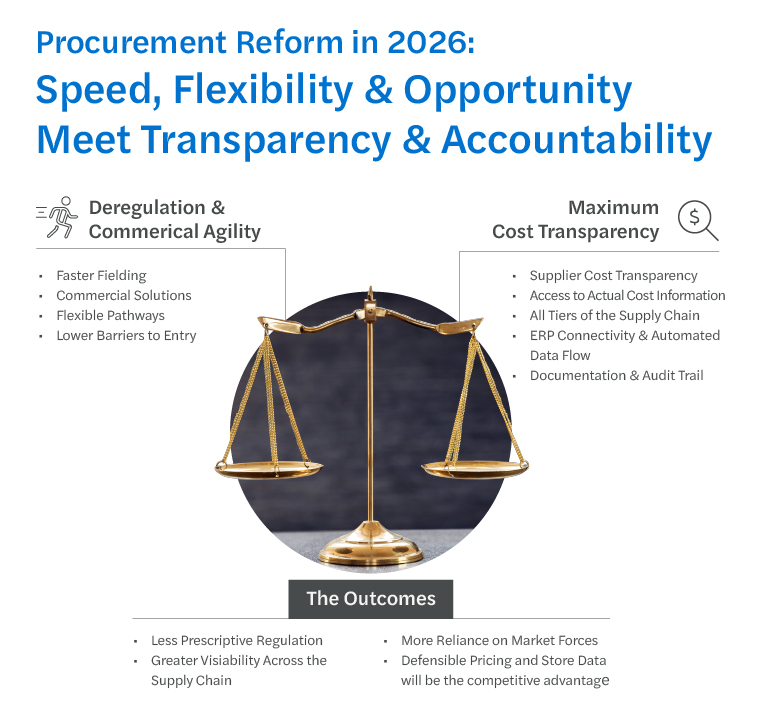
Recent reform efforts have been gathering momentum for years. The Section 809 Panel, National Defense Authorization Act (NDAA) provisions, Revolutionary FAR Overhaul (RFO), recent acquisition speed initiatives, and the Business Operators for National Defense (BOND) initiative are all driven by the concern that the defense acquisition system has accumulated layers of statutes, regulations, audits, reviews, and compliance requirements that impede speed and discourage participation in the Defense Industrial Base (DIB).
If the history of defense contracting has taught us anything, it is that every effort to increase acquisition speed eventually encounters the same obstacle: risk. The government’s response to that risk has traditionally been oversight, audits, business system requirements, certifications, cost and pricing data, and of course, more cost accounting regulations. Over time, however, the accumulation of these risk avoidance controls bogs down the system and adds time and cost to the products and services being delivered.
Recently, the Deputy Secretary of War Steve Feinberg issued two memos of note. The first on August 18, 2026, “Supplier Cost and Pricing Transparency,” followed up on September 14 with “Fostering One Strong Industrial Base.” Both memos are generating significant discussions across the marketplace. The memos send a clear message from the top that the Pentagon wants to take action to accelerate procurement, reduce red tape, and attract innovative commercial companies to the DIB.
The memos direct Pentagon administrative leaders to update current procurement guidance to its contracting professionals. The September memo provides a detailed listing of Implementation Actions directing the Vice Chairman of the Joint Chiefs of Staff, the Under Secretary of War for Acquisition and Sustainment (USW(A&S)), and the USW Comptroller (USW(C)) to take very specific actions over the next three months to advance the Department’s goals.
The Aerospace Industries Association (AIA) posted a statement on the September 14 memo that summarized the marketplace thoughts fairly well:
“The Aerospace Industries Association welcomes the Pentagon’s efforts to lower barriers to entry, increase competition, and make it easier for companies to do business with the military. Many of the reforms outlined in this memorandum, including streamlining business systems requirements and continuing the shift from Cost Accounting Standards toward Generally Accepted Accounting Principles, reflect priorities AIA has long supported and helped advance. At the same time, some aspects, particularly continued demands for extensive cost and pricing data, could undermine the Department’s broader objective of attracting more companies, capital, and innovation into the defense industrial base. We look forward to working together to ensure Pentagon policies deliver the speed, transparency, and competitiveness they seek, while preserving the conditions that enable industry to invest, innovate, and grow.”1
Both memos require full cost transparency across all tiers of the supply chain of contractors and subcontractors to support negotiations for products and services valued at $10 million or more, regardless of whether cost and pricing data requires certification. The memos also mention a goal to establish fair and reasonable contract profit margins by applying commercial best practices tailored to each product or service line.
What Do the Memos Mean for Contractors?
While there are many significant elements of the memos, here are five takeaways:
The Contradiction: Remove Some Barriers While Adding Others – The September 14 memo addresses significant reductions in barriers including Cost Accounting Standards (CAS) and business systems requirements. It also reinforces the fact that a fixed price contractor should retain the profits associated with efficiencies on the contracts that it performs (efficiency assurance). The memo also initiates a task to “revise the Department’s profit policy so that negotiated margins reflect value delivered, risk carried, and private capital invested – not merely cost incurred.”
However, both memos direct acquisition personnel to obtain much greater cost transparency from contractors and suppliers on acquisitions valued at $10 million or more, regardless of whether certified cost or pricing data is required. The August 18 memo directs exploration of automated access to contractor ERP and financial systems through Application Programming Interfaces (APIs).
Herein lies the contradiction.
Expanded access to cost information will likely continue to be a barrier to entry and is directionally opposing the move to broader deregulation efforts. This traditional, intense focus on costs has been identified as a significant barrier for companies entering the DIB for decades.
DoW Wants CAS to Become the Exception Rather Than the Rule – The September 14 memo requires the USW(A&S) and USW(C) to work within existing CAS requirements to use all available CAS relief. This would include:
- Immediately apply the increased CAS thresholds to $35M.
- Prevent the application of a “shadow CAS,” that is, an equivalent of CAS coverage, disclosure, business-system review, or practice-change governance under another name.
- Limit CAS coverage on new solicitations without written approval of the USW(A&S).
- Advance CAS coverage at the CAS Board:
- Propose a “class exemption making exemption the default, with CAS coverage limited to cost-based development contracts of major scale awarded without adequate price competition.”
- Limit coverage that attaches to the covered contract and the indirect-cost pools material to it, with no entity-, segment-, or flow-down attachment.
- Complete CAS-to-GAAP conformance so that GAAP is the baseline and government-unique requirements survive only where cost-based pricing specifically demands them.
- Modernize the Disclosure Statement, that is, a short certification that contract cost accounting follows the contractor’s annual GAAP financial statements, audited by a registered independent public accounting firm, supplemented only by legally required disclosures, with a schedule of departures, in a machine-readable, versioned electronic submission format.
- Recommend the Department’s CAS Board Representative since the 2026 NDAA eliminated the Director of DCAA as a member.
- Clearly, the CAS is not going away. Both the Department and the CAS Board2 are aiming to significantly reduce the burdens of CAS on the DIB. CAS can be changed only through the CAS Board rulemaking process and, in some cases, legislation. Until regulations change, contractors must continue complying with existing CAS requirements on their contracts.
Replace Government-Unique Requirements With GAAP & Commercial Practices – Throughout the September 14 memo, there is a consistent theme: reduce reliance on government-unique cost accounting and compliance frameworks and rely more heavily on commercial accounting and management practices. The memo specifically directs the development of guidance to enforce greater reliance on GAAP and a reduced dependence on specialized government accounting structures.
A fundamental challenge with the Department’s apparent shift from CAS to GAAP is that the two frameworks are designed to accomplish very different objectives. GAAP is intended to provide investors, lenders, regulators, and other stakeholders with a fair presentation of a company’s overall financial position and operating results. It answers questions at the corporate level: Is revenue recognized appropriately? Are assets properly valued? Are financial statements materially accurate?
Government contracting, however, typically requires visibility at a much deeper and granular level of detail. The Department wants to have complete transparency regarding the cost of a specific contract, task order, product line, or program. Oversight officials want to determine whether a direct labor charge, overhead allocation, material cost, or proposed rate is fair and reasonable for a particular procurement. GAAP was never designed to provide that level of contract-specific transparency, consistency, or comparability.
In many respects, this is why the government developed its unique accounting compliance requirements in the first place. Audit oversight based on the FAR Cost Principles, CAS, Truthful Cost or Pricing Data Act (formerly known as TINA) and business system requirements did not emerge because policymakers preferred complexity. These elements were created because oversight teams wanted a transparent mechanism to assess costs at the contract level.
The requirements were designed to bridge the gap between enterprise-level financial reporting and contract-level cost accountability.
As a result, the current acquisition reform debate is not simply about replacing CAS with GAAP. The more fundamental question is whether a framework designed to report financial results at the entity level provides sufficient transparency to evaluate costs at the contract level. If the answer is no, then DoW may eventually find that reducing government-unique requirements also reduces the visibility necessary to negotiate, administer, and oversee contracts effectively.
Business System Reviews May Be Consolidated, Not Eliminated – The September 14 memorandum directs the Department to consolidate estimating, material management and accounting systems into simplified, commercially aligned accounting-system criteria and to retire the separate reviews. There is also direction to limit the application of earned value management requirements, raise the threshold for purchasing system reviews, and permit greater reliance on independent public accounting firm certifications.
That does not mean the underlying controls disappear. Contractors would still need to demonstrate proposal integrity, consistent estimating, accurate cost accumulation and reporting, appropriate inventory and property accounting, and compliance with applicable cost allowability requirements. The proposed reform changes how those controls may be evaluated, rather than eliminating the government’s need for them.
The memorandum also states that no phantom requirements can be established to recreate retired review regimes through local policies, checklists, approvals, or contract clauses. To the extent permitted by law and existing contracts, the Contracting Officers are expected to cease enforcing superseded requirements and remove affected clauses through bilateral, no-cost contract modifications.
Until implementing guidance is issued and contract clauses are formally revised, however, contractors should continue complying with the requirements contained in their existing contracts.
None of This Is Self-Executing – This is probably the most important practical takeaway on the list. With the actions currently underway with updates to CAS and RFO activities, remember that the September 14 memo is policy direction, not regulatory implementation.
Each of these reforms will require CAS Board action, FAR or DFARS changes, updates to agency guidance, and of course, updates to contract clauses. The memo directs the USW(A&S) and USW(C) to submit proposals and pursue reforms, but existing requirements remain in force until formally changed.
What Should Contractors & Subcontractors Do Today?
First and foremost, contractors and subcontractors should not stop complying with CAS or maintaining current business systems. Also, they shouldn’t assume that DCMA and DCAA oversight will disappear overnight. Historically, a relaxation of oversight in any particular area of the defense acquisition process has resulted in redirected emphasis in other areas. Other recommended next steps include:
- Read and understand the memos and closely monitor the implementing guidance as it is issued.
- Stay ahead of your competition by anticipating how these reforms may affect solicitations, cost and pricing expectations, negotiations, and contract administration.
- Use that knowledge to engage proactively with your government customers and primes, differentiating yourself from competitors.
- Demonstrate your ability to support faster, more efficient, and well-informed acquisition decisions.
In conclusion, the memos represent the most aggressive DoW acquisition reform initiative in decades. The overarching message is clear: the Department wants to attract more commercial participation, reduce government-unique compliance requirements, streamline audits and business system oversight, and rely more heavily on market forces and commercial accounting standards.
Remember however, the memos are policy signals, not regulatory change. Until the CAS Board, FAR Councils, and DFARS rulemaking process convert these concepts into enforceable regulations, contractors remain subject to the compliance framework required in existing contracts and solicitations.
The real question is not whether DoW wants to change the system. It is how much of this vision survives the rulemaking process and ultimately becomes incorporated into the DFARS and FAR.
How Forvis Mazars Can Help
At Forvis Mazars, our experienced government contracting professionals work alongside organizations to understand the potential implications of acquisition reform developments and the considerations that may affect their business. As additional guidance and rulemaking activity emerge, we can help you stay informed and evaluate what these changes may mean for your organization. Contact us to continue the conversation.
- 1AIA Statement on DOW Memorandum "Fostering One Strong Industrial Base," Aerospace Industries Association, September, 15, 2026."
- 2“This rule is deregulatory, reduces compliance costs, simplifies CAS administration for existing contractors, and reduces barriers to entry . . .” and in discussing the statutory thresholds, “. . . the changes would reduce the number of CAS-covered business segments by 60 percent.” Federal Register, Vol. 91, No. 168, September 1, 2026.