

In a recent industry briefing, the Securities Industry and Financial Markets Association (SIFMA) presented with Cleary Gottlieb on the done-away clearing model and documentation for the U.S. Department of the Treasury (Treasury) centralized clearing. The done-away model is new to Treasury clearing and will allow trades to be executed by one broker and cleared through a separate clearing provider.1 This model differs from current models and is a major milestone for the industry as the model supports the SEC U.S. Treasury clearing mandate. As a reminder, the SEC has mandated that the following transactions must be centrally cleared by a covered clearing agency by the following dates:
- December 31, 2026 – cash market transactions
- June 30, 2027 – repo market transactions
During the briefing, SIFMA reaffirmed the market’s expectation that regulators will not grant any additional extensions to the deadlines in the mandate. As such, industry participants should work toward full compliance by these dates.
This table outlines some key terms that are used in connection with the Treasury Centralized Clearing at Fixed Income Clearing Corporation (FICC).
| Key Terms | Definition |
|---|---|
| Covered Clearing Agency (CCA) | A clearing agency registered and approved by the SEC to act as a central counterparty to Treasury cash and repo transactions. |
| Central Counterparty (CCP) | The entity that stands in the middle of a Treasury cash or repo transaction. For Treasury clearing, the CCA and CCP are the same entities. |
| Direct Member | An entity that has direct access to the CCA and can submit, clear, and settle trades with the CCA. These entities are usually broker-dealers or banks. |
| Sponsoring Member | A direct member that sponsors indirect members to submit trades to be centrally cleared. |
| Indirect Member | An entity that does not have access to a CCA and is reliant upon a direct member to submit trades on its behalf. These entities are often times hedged funds or money market funds. |
| Sponsored Member | An indirect member that relies upon a Sponsoring Member to submit trades. |
| Clearing Firm | A firm or entity that is responsible for submitting the trade to the CCA and a direct member. |
| Executing Firm | A firm or entity involved in negotiating a trade but does not have direct access to FICC. |
| Novation | Legal process whereby trades submitted to a covered clearing agency are matched and now the CCA is the counterparty to both sides of a trade. |
Traditionally, Treasury transactions have been settled and cleared bilaterally or centrally cleared through the FICC. For decades, FICC has been the only CCA for Treasury outright cash and repo transactions. However, recently, Intercontinental Exchange (ICE) Clear Credit and CME Securities Clearing Inc. have received SEC approval to be CCAs and are working towards implementing processes that will allow them to centrally clear Treasuries as an alternative to FICC.2 3
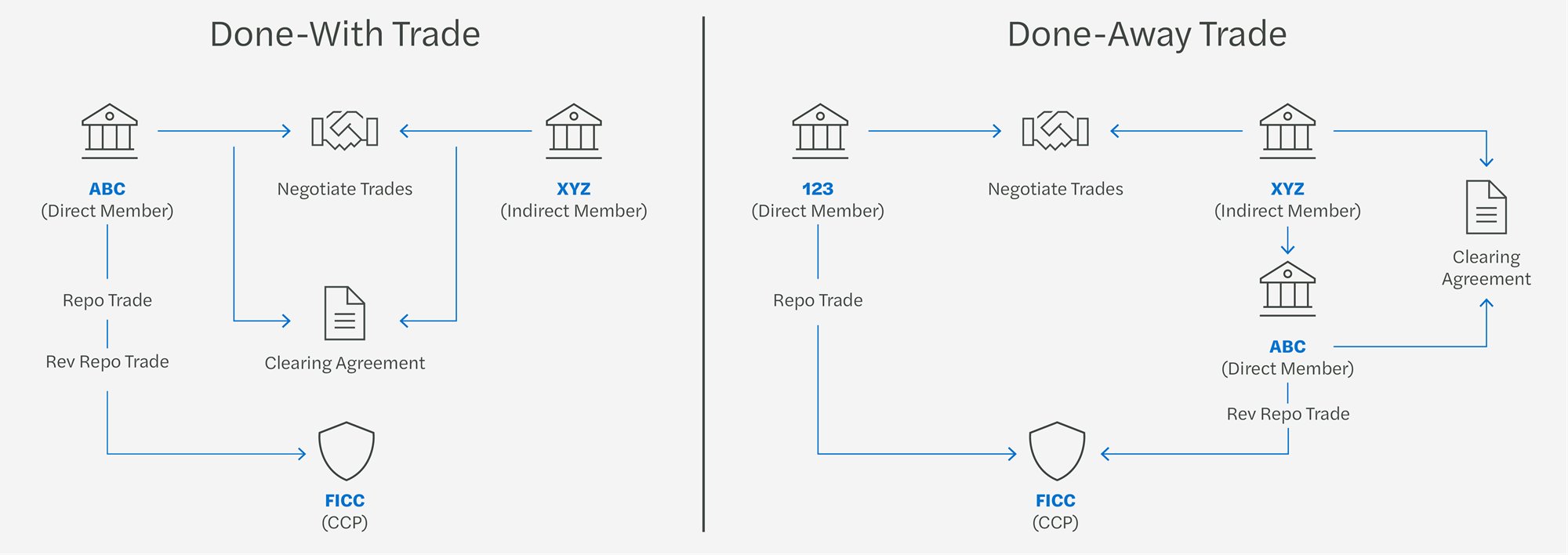
The done-with clearing model has been available since 2005.4 As the industry moves towards the clearing mandate, this model is expected to remain as the primary clearing model. This model requires an indirect member to have a clearing agreement with a direct member in order to transact in outright cash or repo transactions that are centrally cleared.
One way in which an indirect member can centrally clear cash and repo trades through FICC is by becoming a sponsored customer through its direct member. This sponsorship is part of a clearing agreement between the direct and indirect members. Direct members will submit trades on behalf of indirect members to be centrally cleared at the FICC. Once the trades are submitted, the FICC will novate the trades and become the counterparty to both the direct member and indirect member. Done-with clearing requires indirect members to have a clearing agreement with each direct member it wishes to also use as an executing firm. This can severely limit the number of executing firms available to an indirect member.
Many indirect and direct members trade U.S. transactions bilaterally in the market today (cash and repos). The centralized clearing mandate will prohibit most bilateral trading of U.S. Treasuries which will likely put a restraint on the number of market participants.
Expanded Clearing: Done-Away Clearing
The done-away model will allow trades to be executed in several different ways and is important to the expansion of market participation. Trades can occur between two indirect members or a combination of direct and indirect members. This activity will enhance price competition and increase liquidity by increasing the number of market participants.
An indirect member will still be required to have a clearing agreement with a direct member. If the executing firms are indirect members, they must have a direct member submit their trades to FICC. If the executing firms are direct members, they may submit their own trades. The done-away model will allow indirect members to maintain one agreement with a direct member and execute trades with other indirect or direct members.
While the done-away model may expand competition and liquidity, the model may also introduce new risks. Since market participants can execute trades with one counterparty and clear through a different clearing member, this model can create additional operational, counterparty and credit risks for clearing members.
Examples of Done-With & Done-Away Models
Sponsored Model vs. Agency Clearing Model
Done-away and done-with trades can clear through the FICC’s sponsoring model or through the agent clearing model (ACM). During the industry briefing, SIFMA indicated that it expects firms to continue using the sponsoring model since it is operationally familiar.
ACM is a newer model where direct members will still submit trades on their customers’ behalf (indirect members) within an agency capacity. The primary difference is the legal access and privity with the FICC. Under the Sponsored Model, sponsored customers, e.g., hedge funds or money market funds, will be limited members with FICC, and their margin requirement is calculated and segregated on a gross basis. Under ACM, the customers do not have legal membership with FICC and their margin is calculated and unsegregated on a net basis.5
Standardized Agreements
SIFMA has developed standardized documentation and master agreements for the industry to use for done-away clearing models. These documents and agreements differ from done-with agreements, which are often amendments to existing clearing agreements already in place. SIFMA’s new standard documentation is aimed at reducing legal costs while creating efficiencies in the implementation of multiple agreements under the new clearing model.
SIFMA now has master agreements available on their website for centralized clearing done-away clearing with FICC. While the master agreements aim to be standardized, they will require firms to assess items such as default events, rejection events, and the trade submission details. SIFMA will provide similar agreements when other CCAs (ICE and CME) are up and running.
Regulatory Reporting Impacts
The SEC has amended 15c3-3 for broker-dealers to include a debit for margin required and on deposit with a qualified clearing agency. The FOCUS Report has a new reporting line to reflect the new includable debit (FOCUS Line 12843). The specific requirements for the allowable debit are outlined in 15c3-3a (Note H).
The amendments to 15c3-3 have proven to be a major lift for broker-dealers that are required to collect margin and onward posting to the FICC. In addition, broker-dealers are faced with the critical importance of avoiding the commingling of customer margin with the broker-dealer’s house account.
For broker-dealers that collect margin from clients under the done-with and done-away model, there could be a material impact on customer credits. Broker-dealers that are required to perform 15c3-3 computations weekly should continue to monitor credits if they are approaching the $500 million threshold, as crossing this threshold could require daily computations.
Additional Considerations for Broker-Dealers:
- Broker-dealers should consider how stock records and allocation hierarchies should be reflective of customer margin. Designating specific allocation coding and segregation will ensure that customer margin is not commingled when performing the 15c3-3 computation.
- Furthermore, broker-dealers should consider new stock record allocations related to centralized clearing. These allocations can include designating categories for centrally cleared reverse repos, repos, and fail-to-deliver and receive with CCPs.
- Consider updates to Written Supervisory Procedures (WSPs) and Standard Operating Procedures (SOPs) for any operational changes to trade flows, reconciliations, and updated customer accounts.
- With increased FICC centralized clearing, firms may see increased net capital relief repurchase and reverse repurchase deficits (refer to rule 15c3-1(c)(2)(iv)(F/05)).
- There should be expected balance sheet netting of reverse repos and repos as FICC will be the CCP.
What’s Happening Next
SIFMA is continuing to work toward the widespread adoption of the done-away model. This work will include providing updates on operational implementation and the impact on the industry.6
Customer Protection
On June 24, 2026, SIFMA sent a request to the SEC to request relief on the 15c3-3 Customer and Proprietary Account of a Broker-Dealer (PAB) formula. SIFMA has requested that broker-dealers be allowed to include a debit in the formula when the margin is calculated on an omnibus basis, rather than gross customer-by-customer segregation at FICC. On July 24, 2026, the SEC requested additional public comment on the topic of allowing broker-dealers to use net omnibus margin calculations rather than gross customer-by-customer calculations for centrally cleared Treasuries. The SEC has yet to provide regulatory updates.
As part of the June 24 request, SIFMA also requested relief and clarity from the SEC on Rule 15c3-3a Note H(b)(1)(iii). This relief is if broker-dealers may temporarily use proprietary cash in the same way they can use proprietary Treasury securities and still include Rule 15c3-3 reserve formula debit.
The final item in the SIFMA relief request was related to customer fully paid and excess margin securities that are pledged to a CCA. SIFMA has requested clarification from the SEC to ensure that posting these customer securities to satisfy a margin requirement at a CCA does not constitute a deficiency when broker-dealers calculate possession or control calculations.7
Relief for Affiliate Transactions
On April 10, 2026, SIFMA requested expanded relief from the SEC for certain affiliates of clearing members that transact in the Treasuries be exempt from being centrally cleared. This includes expanding relief of centralized clearing to all affiliates (except for Investment Companies) and non-U.S. affiliates.8
How Forvis Mazars Can Help
The mandate and transition to centrally clear U.S. Treasury transactions is one of the most significant changes to the industry and broker-dealers in recent years. Firms must assess the operating models and the impact to customer reserve computations, net capital computations, possession or control requirements, margin processes, and other regulatory implications. Broker-dealers should expect a focus on governance, documentation, and the accuracy of these changes from regulators and auditors.
Our team at Forvis Mazars can assist you with 15c3-3 customer and PAB reserve impact assessments, 15c3-1 net capital impact assessments, control design, and assistance with documenting policies and procedures that are needed to ensure compliance and adhere to the complex changes to updated operating models.
Our professionals serve companies on financial services industry-leading projects, and we look forward to helping your organization achieve its goals. We possess the regulatory domain knowledge and industry experience that you can trust, combining a focus on delivering an Unmatched Client Experience® with the resources of a global firm. For more information, please reach out to our team at Forvis Mazars.
- 1“2026 SIFMA Master Treasury Securities Clearing Agreement: Done-Away,” sifma.org, August 2026.
- 2“ICE Clear Credit’s Treasury Clearing Service Receives SEC Approval and is Now Operationally Live,” ir.theice.com, February 3, 2026.
- 3“CME Group Announces Regulatory Approval of New Securities Clearing House,” cmegroup.com, December 2, 2025.
- 4“FICC’s Client Clearing Capabilities for Treasury Market Activity,” dtcc.com, November 2024.
- 5“Agent Clearing Service,” dtcc.com, August 2026.
- 6“Treasury Clearing,” sifma.org, August 2026.
- 7“Application of the Broker-Dealer Customer Protection Rule with Respect to U.S. Treasury Securities Clearing,” sigma.org, October 23, 2024.
- 8“Request for Exemptive Relief from the Clearing Rule for Certain Inter-Affiliate Transactions,” sifma.org, April 10, 2026.